IGCSE · 25 September 2026 · 6 min read
IGCSE Physics moments questions: pivots, distances and equilibrium
A moments question can look like a puzzle about which numbers to multiply. It becomes more predictable when you first draw the forces and choose a pivot. Each force then has a direction of rotation and a perpendicular distance that belongs specifically to that force.
The original examples below cover a simple balance, a beam with its own weight and a practical lever. They are designed to build method for IGCSE questions rather than provide a catalogue of memorised arrangements. Unless stated otherwise, beams are horizontal, forces are vertical and the system is stationary.
Measure from the pivot to the line of action
The moment of a force is force × perpendicular distance from the pivot to the force's line of action. For a vertical force on a horizontal beam, that distance is horizontal. It is not necessarily the full length of the beam, nor the gap between two loads. Mark the pivot first and draw the shortest perpendicular connection to the relevant line of action.
A force acting through the pivot has zero moment about that pivot, even if the force is large. This is why choosing a support as your pivot can simplify a calculation: its unknown reaction force disappears from the moments equation. The reaction still exists and will matter when you later balance vertical forces.
Worked example: balance two turning effects
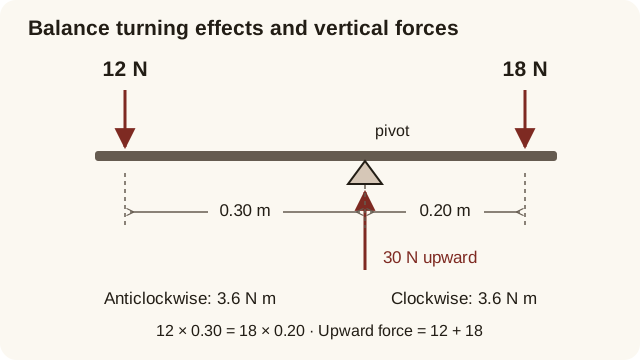
A light beam is supported at a pivot. A 12 N downward force acts 0.30 m to its left. What downward force placed 0.20 m to its right balances it? The left force produces an anticlockwise moment of 12 × 0.30 = 3.6 N m. The right force must produce an equal clockwise moment: F × 0.20 = 3.6, giving F = 18 N.
The larger force acts at the shorter distance, which is physically reasonable. A common incorrect approach sets 12 + F = 0 or simply makes the forces equal. The pivot supplies an upward reaction of 12 + 18 = 30 N, so vertical forces can balance while the two downward loads are unequal. Rotational and translational balance are separate conditions.
Worked example: include the beam's own weight
A uniform 2.0 m beam weighs 40 N and is supported at both ends. An additional 60 N load is 0.50 m from the left end. Find the right support force R. Take moments about the left support. The beam's own weight acts at its midpoint, 1.0 m from the left, so R × 2.0 = (40 × 1.0) + (60 × 0.50) = 70 N m. Therefore R = 35 N upward.
The total downward force is 100 N, so the left support force is 100 − 35 = 65 N upward. The larger reaction is on the side nearer the extra load, matching intuition. Taking moments about the right support provides an independent check: 65 × 2.0 = 40 × 1.0 + 60 × 1.50 = 130 N m.
Distinguish a light beam from a uniform beam
If a question says a beam is light or has negligible weight, its own weight can be ignored in the model. If it says uniform, that tells you the centre of mass is at the geometric midpoint for a straight beam of constant cross-section; it does not say the beam is weightless. Include its weight whenever it is relevant and supplied or calculable.
If mass is given, convert it to weight using W = mg and the value of g specified in the question or appropriate to the stated context. A mass in kilograms is not a force in newtons. Using 2 kg directly in a moment equation alongside forces in newtons mixes quantities and can conceal a missing factor of g.
Explain why a longer handle helps
A force applied at right angles farther from a pivot produces a larger moment. For a required turning moment, a larger perpendicular distance therefore allows a smaller force. The useful phrase is perpendicular distance: pushing along a spanner's handle gives little or no turning effect about the bolt even when the hand is far from it.
Do not label the unit of moment as a joule just because N m is dimensionally equivalent to a joule. In this context, N m identifies a turning effect. Work is an energy transfer associated with displacement in the force direction. Keeping the quantity's name beside its unit helps prevent confusing these different physical ideas.
Independent practice: solve and check a lever
A light horizontal lever has a 150 N load 0.12 m to the left of its pivot. A downward effort acts 0.45 m to the right. Find the effort needed to balance the load, then the upward pivot force. The load's moment is 150 × 0.12 = 18 N m. Balancing moments gives F = 18 / 0.45 = 40 N. The upward pivot force is 150 + 40 = 190 N.
If the effort were moved closer to the pivot while the load stayed fixed, the required effort would increase. For every practice problem, label the pivot, show both moment directions and check the force balance when reactions are requested. Mark your drawing as well as your arithmetic, then try a changed arrangement in a later session. That tests whether the correction has become a method you can use independently.
Questions, explained
Choose a question for a direct answer, then explore the explanation and supporting resources. Each answer has its own link to save or share.
Which distance do I use when calculating a moment?
Use the perpendicular distance from the pivot to the force's line of action. For a vertical force on a horizontal beam, this is the horizontal distance from the pivot to where the force acts. Do not automatically use the beam's full length or the separation between loads. Drawing the force's line of action makes the correct distance clear.
When should I include the weight of the beam?
Include it when the beam's weight is relevant to the stated model. For a uniform beam, the weight acts at its centre of mass at the midpoint. A light beam or one explicitly described as having negligible weight can be treated as weightless. Uniform describes the distribution of mass; it does not mean that there is no weight.
Does equal clockwise and anticlockwise moment prove equilibrium?
It establishes zero resultant turning effect about that pivot, but complete static equilibrium also requires zero resultant force. In a simple supported beam, the upward support forces must equal the total downward weight and loads. A support can exert a substantial force while producing no moment about its own point of application.