Edexcel M1 Mechanics tutor
Edexcel M1 Mechanics tutoring starting with the model.
A-Level Mathematics · Forces, motion & moments · Live online
Dr Mohamed Desouky teaches Edexcel International A-Level Mathematics Mechanics 1 through live online lessons. Students learn to turn words into diagrams, choose a clear model and set up the equations before solving a problem.
M1 is a Mathematics unit covering vectors, motion, forces, statics and moments. Its exam paper code is WME01/01. Online groups cost AED 150 per 90-minute session, with timings agreed directly.
Before you join
How the classes work
- Live online tuition
- AED 150 per 90-minute group session.
- Group size
- Around 20 students per group. Confirm the current group when enquiring.
- Catch-up recordings
- Students who join a group receive recorded sessions to help them catch up.
- Parent communication
- Parents are kept informed and can contact Dr Desouky with questions at any time.
Timetables differ by exam board. Send your qualification and intended exam session to confirm the current days, times, time zone and available places.
- Share your board, course level and exam session.
- Discuss the topics you need help with and check the matching group.
- Confirm the timetable, fees and joining arrangements with Dr Desouky.
Edexcel M1 WME01/01 exam structure
WME01/01 is an externally assessed Mechanics 1 paper for Pearson Edexcel International AS and A Level Mathematics. It lasts 1 hour 30 minutes, carries 75 marks, requires students to answer all questions and permits an approved calculator.
The specification covers mathematical models in mechanics; vectors in mechanics; kinematics of a particle moving in a straight line; dynamics in a straight line or plane; statics of a particle; and moments. Questions reward clear method, so unsupported answers can leave marks behind.
Why Edexcel M1 students lose method marks
Common failures begin with interpretation: treating a rough surface as smooth, reversing friction, mixing mass and weight, assigning inconsistent positive directions, or using a constant-acceleration equation where the conditions do not support it.
The course teaches students to state or recognise the model, draw and label the situation, choose axes and directions, then write equations. This order makes mistakes easier to spot and produces working an examiner can follow.
Kinematics, vectors and connected motion
Straight-line motion requires more than memorising SUVAT. Students learn when the constant-acceleration model applies, how displacement differs from distance, how a velocity-time description controls the signs, and how to keep exact values until the final answer.
Vector and multi-particle questions add geometry and constraints. Training makes the shared motion or connection explicit before simultaneous equations are formed, reducing the temptation to guess which force belongs in which equation.
Dynamics, statics and moments
Newton's laws become dependable when every force has a source and direction. Students practise resolving forces, friction and reactions, equilibrium, momentum and impulse within the models specified for M1.
For moments, the decisive quantity is perpendicular distance. Diagrams are redrawn around the pivot, clockwise and anticlockwise effects are organised visibly, and equilibrium equations are checked against the physical situation before algebra begins.
How Edexcel M1 Mechanics tutoring works
Each live online group session lasts 90 minutes and costs AED 150. Schedules are agreed with students and groups, allowing teaching to track their unit plan and WME01/01 examination date.
Weekly homework is checked individually for model, diagram, method and accuracy—not only the final answer. Regular exams build 75-mark-paper stamina, and direct WhatsApp access gives students a way to ask Dr Desouky about a disputed force, sign or step between sessions.
Who the WME01 Mechanics 1 course is for
The course is for Pearson Edexcel International Mathematics students entered for WME01/01, whether they are learning M1 for the first time, preparing for a resit or finding that strong pure mathematics does not automatically translate into mechanics marks.
It is particularly useful for students who can complete algebra once an equation is given but struggle to construct that equation from a physical description. The focus stays on the M1 specification rather than drifting into later Mechanics units.
Questions
Questions, answered
Choose a question for a direct answer, then explore the explanation and supporting resources. Each answer has its own link to save or share.
Which Edexcel Mechanics 1 paper does this course cover?
This course covers Pearson Edexcel International AS and A-Level Mathematics Mechanics 1, paper WME01/01. Dr Desouky teaches it through a separate live online M1 group. It is important to check that code because a Physics mechanics paper or another Mathematics specification requires different preparation.
When enquiring, share WME01/01, the intended exam series and the topics currently being studied. A recent question with your own working is more informative than only naming a target grade: it shows whether help is needed with the model, force diagram, sign convention or mathematical solution.
How long is the WME01/01 exam and how many marks is it worth?
Edexcel WME01/01 lasts one hour 30 minutes and is worth 75 marks. Students answer all questions, and an approved calculator may be used. Preparation should include clear written modelling and working as well as practice completing the full paper within its time limit.
A calculator does not decide the model or the correct sign. Show the physical equation before substituting numbers, and keep enough working for the method to be checked. When reviewing a timed paper, separate marks lost through running out of time from marks lost through an incorrect setup; the remedies are different.
What topics are taught for Edexcel M1?
Edexcel M1 tuition covers mathematical models, vectors, straight-line kinematics, dynamics, particle statics and moments, including the momentum, impulse and constant-acceleration relationships needed for WME01/01. Practice focuses on selecting a model and constructing equations from the situation described, not only applying a formula already supplied.
Be precise about the conditions. A smooth surface has no friction in the model; a particle model neglects the object's size; a light string has negligible mass. Each assumption affects the equations you can write. Learn what the assumption permits rather than memorising the word without its mathematical consequence.
Is M1 taught as physics or mathematics?
WME01/01 is an Edexcel International Mathematics unit. Dr Desouky uses physical reasoning to establish a valid model, then develops the equations, notation and working required for M1. It is taught separately from Edexcel IAL Physics, whose units use WPH11–WPH16 codes.
Physical understanding helps you decide which forces act and which quantities are conserved. The Mathematics examination then needs that reasoning expressed through a clear model and a correct solution. Studying both subjects can reinforce ideas, but each still needs practice with its own specification and papers.
Can tutoring help if the algebra is fine but modelling is weak?
Yes. M1 tuition works through the setup explicitly: interpret the description, draw the forces, choose directions, write the physical equations and then solve. This makes a missing force, inconsistent sign or unjustified assumption visible before it becomes hidden inside otherwise correct algebra.
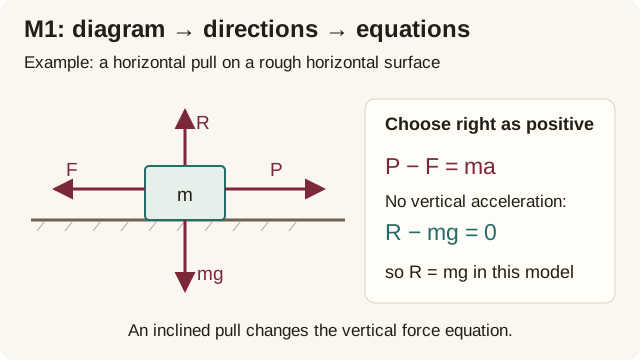
For a horizontal pull on a block moving on a rough horizontal surface, the horizontal resultant is pull minus friction when right is positive. Vertically, the normal reaction balances weight because there is no vertical acceleration in this model. If the pull were inclined, that vertical equation would change; the diagram must come before the remembered equation.
How much does Edexcel M1 tutoring cost?
Online Edexcel M1 Mechanics tutoring costs AED 150 per 90-minute live online group session. Groups are around 20 students, and the schedule varies by board and group. Students who join receive recorded sessions to help them catch up.
The timetable is agreed with the group. Weekly homework is checked individually, regular exams are set and students can ask Dr Desouky questions directly on WhatsApp. M1 is advertised here as live online tuition, so use the enquiry to confirm the appropriate WME01/01 group and its current schedule.
In M1, is friction always equal to coefficient of friction times reaction?
No. In the standard M1 model, static friction adjusts up to a maximum value of μR. Equality applies at limiting equilibrium; before that limit, friction can be smaller. The model used for sliding friction also uses μR. Decide the state of motion before writing the friction equation.
Imagine a small horizontal pull on a rough block that stays at rest. Friction balances that pull, even when the pull is much less than μR. Automatically substituting μR would invent a larger friction force and destroy the equilibrium. Look for evidence that the particle is on the point of moving or is sliding before using equality.
How should I set up a connected-particle M1 question?
Draw a separate force diagram for each particle, choose consistent directions and identify the connection between their motions. Write Newton's second law for each particle using its own forces, then solve the linked equations. Equal acceleration magnitudes or equal tensions follow from the stated model, not from every possible connection.
For the usual taut, inextensible string over a smooth pulley with a light string, the model connects the particles' acceleration magnitudes and gives a common tension. Keep weight and tension on the correct particle's diagram. A slack string or a different pulley model would require reconsidering those assumptions rather than reusing the same equations automatically.
Find your physics class
Your next chapter starts with one message.
Tell Dr Desouky your level, exam board and city. Choose in-person physics lessons in Abu Dhabi or live online lessons across the UAE and Gulf.
AED 150 · 90-minute live online session
Contact Dr Desouky for in-person availability, location and fees.