A practical revision system
How to revise Physics.
One useful step at a time.
Find the gap. Understand the idea. Apply it on your own. Use feedback to decide what comes next. A repeatable route through IGCSE, AS and A-Level revision, with free guides and teaching support when you need it.
Choose your starting point
What needs to change in your next session?
Choose the difficulty you need to work on. The plan will connect a useful explanation, independent practice and a follow-up task.
Use your current board specification alongside these independent resources. The diagnostic is a small skills sample, not a predicted grade or a full syllabus test.
A starter session · 40 minutes
Turn a difficult idea into something you can use.
Choose one idea you cannot explain. Describe it without notes, name the missing step and use a diagram to rebuild it.
First check your course. The board finder helps identify the right specification before choosing exam-specific material.
0 of 4 steps checked
Finishing a checklist is a record of practice, not proof of mastery. Check transfer with a fresh question, then use the revision planner to schedule the next attempt.
The repeatable method
Build a revision routine you can repeat.
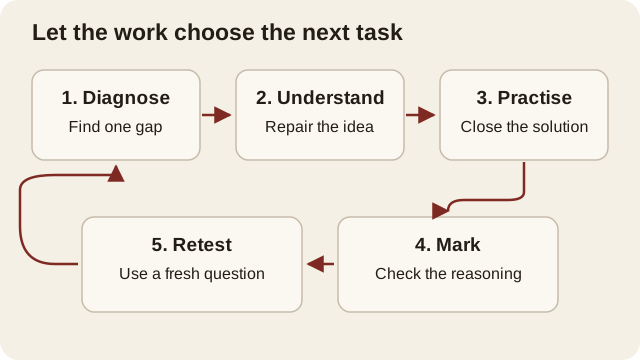
Begin with evidence: a question you cannot start, a definition you confuse or a mark you cannot explain losing. Study only far enough to repair that gap, then put the explanation away and use the idea independently.
For example, a wrong moment calculation may come from choosing the wrong distance. Redraw the force and pivot, identify the perpendicular distance, then try a different arrangement. Record the correction as a decision you can repeat, not just a corrected number.
As topics become more secure, mix them and attempt timed papers from the right board. Keep practical skills and written explanations in the cycle alongside calculations.
Choose the guide for your next step
How to revise IGCSE Physics
Topic understanding, board-specific practice and practical skills.
Read the guide →How to revise AS and A-Level Physics
Models, multi-step calculations and connected reasoning.
Read the guide →When the topic does not make sense
Rebuild one missing link without restarting the entire course.
Read the guide →Active recall and spaced practice
Retrieve, apply and revisit instead of repeatedly rereading.
Read the guide →Keep a useful error log
Turn a marked paper into the next practice task.
Read the guide →Revise with lesson recordings
Pause, predict and practise after a recording.
Read the guide →From revision to supported learning
Work through the difficult part with Dr Desouky.
If the same obstacle keeps returning, bring your attempted work to a course discussion. For this revision focus, useful support includes clear explanations and questions that reveal where understanding breaks down. Dr Desouky’s courses combine live explanations, checked homework, regular assessments and support between lessons.
- Around 20 students per online group
- Recordings for enrolled students to catch up
- Parents kept informed and welcome to ask questions
- Timetable matched to the exam board
Live online groups: AED 150 per 90-minute session. In-person Physics sessions are in Khalidiya, near Abu Dhabi Corniche; confirm in-person fees separately. Students in Dubai, Sharjah and across the Gulf can join online.