A-Level · 25 September 2026 · 6 min read
SHM graph questions: connect displacement, velocity and acceleration
Three graphs describe the same oscillation, but they do not reach their maxima together. The quickest reliable way to connect them is to use gradients and directions, rather than trying to remember a picture of three shifted waves.
The worked examples assume ideal, undamped simple harmonic motion. Real oscillations may lose energy, and a periodic motion is not automatically SHM. Keep those assumptions explicit when interpreting a graph or deciding whether a proposed model fits the behaviour described.
Begin with the defining relationship
SHM requires acceleration to be proportional to displacement from equilibrium and directed towards equilibrium: a = −ω²x. A straight-line acceleration-against-displacement graph through the origin with a negative gradient supports that model. Its gradient is −ω², so taking the square root of the magnitude gives angular frequency, provided the axes use consistent SI units.
The minus sign matters physically. When x is positive, acceleration is negative; when x is negative, acceleration is positive. A graph that shows a repeating motion alone does not establish this relationship. When asked to justify SHM, connect the measured force or acceleration to displacement instead of simply stating that the motion repeats.
Build the other graphs from the displacement gradient
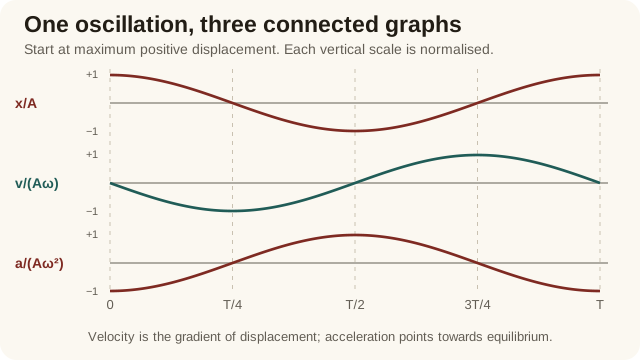
Choose the start at maximum positive displacement, so x = A cos(ωt). Initially the displacement graph is horizontal: velocity is zero. As displacement falls towards equilibrium, its gradient is negative, giving a negative velocity. At the first equilibrium crossing the slope is steepest and speed is maximum, even though displacement and acceleration are both zero.
At the negative turning point, velocity is again zero and acceleration is positive, towards equilibrium. For this starting convention, v = −Aω sin(ωt) and a = −Aω² cos(ωt). Displacement and acceleration are half a cycle out of phase. Displacement and velocity are a quarter cycle apart, with the signs fixed by the direction of travel.
Calculate the maximum speed and acceleration
An oscillator has amplitude 0.040 m and period 0.80 s. Angular frequency is ω = 2π/T = 7.85 rad s⁻¹. Its maximum speed is Aω = 0.314 m s⁻¹, and its maximum acceleration magnitude is Aω² = 2.47 m s⁻². Report values at a precision appropriate to the supplied data, keeping additional digits during intermediate steps.
The maxima occur at different positions: maximum speed at equilibrium and maximum acceleration magnitude at either turning point. Do not assign both to the same instant simply because both formulas use amplitude. If the graph shows peak-to-peak displacement, divide that range by two to find A; the full vertical excursion is not the amplitude.
Handle speed and direction at an intermediate position
For the same oscillator at x = +0.024 m, acceleration is −ω²x = −1.48 m s⁻². Its speed follows v² = ω²(A² − x²), giving |v| = 0.251 m s⁻¹. However, displacement alone does not identify the velocity sign: the oscillator passes that position once moving towards equilibrium and once moving away during each cycle.
If it is moving from the positive turning point towards equilibrium, velocity is negative. If it is returning from equilibrium towards that turning point, velocity is positive. A position question with no direction information may support a speed answer but not a unique signed velocity. Use the accompanying graph or motion statement before selecting the sign.
Explain the energy changes between those positions
For a horizontal ideal spring oscillator, total energy is ½kA². At displacement x, elastic potential energy is ½kx² and kinetic energy is the difference. Thus the kinetic-energy fraction is 1 − x²/A². At x = 0.60A, the potential-energy fraction is 0.36 and the kinetic-energy fraction is 0.64; the speed is 0.80 of its maximum value.
In a damped oscillator, energy is transferred to the surroundings and amplitude decreases. Do not claim that mechanical energy stays constant merely because the motion still looks approximately sinusoidal over a few cycles. Read the envelope of successive peaks and distinguish a loss of amplitude from a change of period; they are different observable features.
Practise reading a period from acceleration data
An acceleration-against-displacement graph has gradient −25 s⁻². Find the angular frequency and period. Since the gradient equals −ω², ω = 5.0 rad s⁻¹ and T = 2π/5.0 = 1.26 s. A gradient of −25 does not mean the frequency is 25 Hz, and angular frequency is not the same quantity as cycles per second.
Now imagine the period halves while amplitude remains fixed. Angular frequency doubles, maximum speed doubles and maximum acceleration becomes four times as large. Explain each change from its equation rather than guessing that everything doubles. This comparison tests whether you understand the different powers of ω and prepares you for unfamiliar graph scales and altered oscillator parameters.
Questions, explained
Choose a question for a direct answer, then explore the explanation and supporting resources. Each answer has its own link to save or share.
Why is acceleration largest when velocity is zero in SHM?
At a turning point, displacement from equilibrium has its greatest magnitude, so the restoring force and acceleration have their greatest magnitudes. Velocity is zero only momentarily while its direction reverses. Zero velocity does not imply zero acceleration: the acceleration is what changes the velocity and starts the return journey towards equilibrium.
Should I use sine or cosine for an SHM displacement equation?
Choose the expression that matches the starting conditions and direction. Starting at maximum positive displacement gives x = A cos(ωt). Starting at equilibrium while moving in the positive direction gives x = A sin(ωt). Other starting conditions need a phase shift or sign change. Both functions describe SHM; the time origin determines the convenient form.
Is the distance travelled in one SHM cycle equal to the amplitude?
No. During a full cycle the oscillator travels between both turning points and returns to its starting position, giving a total distance of 4A. Its displacement after that cycle is zero. The amplitude A measures the greatest displacement from equilibrium, while the turning-point separation is 2A. Keeping these three quantities distinct prevents mistakes in average-speed questions.