A-Level · 25 September 2026 · 6 min read
Electric and gravitational fields: compare the reasoning, not just the equations
The resemblance between gravitational and electric equations is useful, but copying one formula into the other can hide important differences. The sign of charge, the direction of a vector and the choice of zero potential all change how an answer should be interpreted.
This guide connects the two topics through original comparison questions. It focuses on the reasoning needed for A-Level problems rather than treating the equations as a substitution list. Unless stated otherwise, use isolated point sources, or suitable spherical sources outside their surfaces, with potential zero at infinity.
Separate the field from the object experiencing it
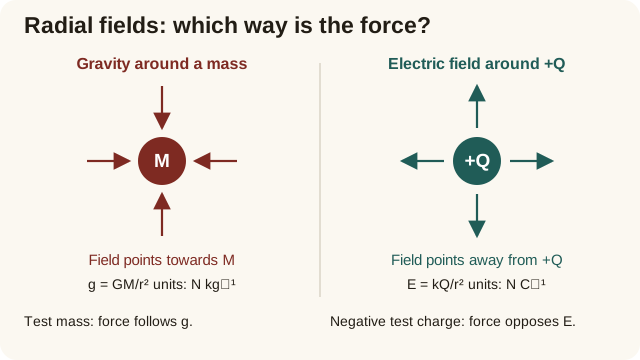
A source mass creates a gravitational field; a small test mass experiences a force in that field. Write g = F/m, so the force on a test mass is F = mg. An electric field is defined using a positive test charge: E = F/q. A negative charge experiences a force opposite to the direction of E, even though the field at that point is unchanged.
In these definitions the test object is assumed not to significantly disturb the source arrangement. A diagram should distinguish the source, the field arrow and the test object. Labelling all three prevents the common claim that an electric field reverses whenever an electron is placed in it: the force reverses relative to the field, not the field itself.
Compare inverse-square strength with inverse-distance potential
For an isolated source mass, the field magnitude is GM/r² and the gravitational potential is −GM/r. For a point charge, the radial electric field component is kQ/r² and the electric potential is kQ/r, where k = 1/(4πε₀). Increasing distance by a factor of two reduces the field magnitude to one quarter but the potential magnitude to one half.
Potential is a scalar, so add potentials algebraically. Field strength is a vector, so directions matter when combining fields. At the midpoint between two identical positive charges, the fields cancel while the potentials add to a positive value. A zero field at a point therefore does not imply zero potential there.
Use one numerical example to track charge signs
Take a positive source charge of 2.0 nC and a point 0.30 m away, using k = 9.0 × 10⁹ N m² C⁻². The electric field magnitude is 200 N C⁻¹ and points away from the source. The potential is +60 V. Both values describe the location before a test charge is specified.
Place a −3.0 nC test charge there. Its force has magnitude |q|E = 6.0 × 10⁻⁷ N and points towards the source. Its electric potential energy is U = qV = −1.8 × 10⁻⁷ J. The negative energy is relative to the chosen zero at infinity; it is not a negative amount of kinetic energy or a contradiction.
Explain the negative gravitational potential
With gravitational potential defined as zero at infinity, a mass at a finite distance in an attractive field has negative potential energy. Positive work must be supplied to move it slowly out to infinity. Moving away from the source makes the potential less negative: it increases towards zero, even though its magnitude decreases.
Suppose GM = 4.0 × 10¹⁴ m³ s⁻². At r = 1.0 × 10⁷ m, the potential is −4.0 × 10⁷ J kg⁻¹. At twice that radius it is −2.0 × 10⁷ J kg⁻¹. Moving a 200 kg object between those radii increases gravitational potential energy by 200 × 2.0 × 10⁷ = 4.0 × 10⁹ J, before accounting for any change in kinetic energy.
Read force direction from a potential gradient
Along a chosen coordinate, field strength is the negative gradient of potential: Eₓ = −dV/dx for electricity and gₓ = −dφ/dx for gravity. A positive electric charge tends to accelerate towards lower electric potential if the electric force is the only force. An electron's negative charge reverses the relation between field direction and force.
For a uniform field between ideal parallel plates, the field magnitude is the potential difference divided by separation, E = |ΔV|/d, away from edge effects. That constant-field relationship should not replace the inverse-square expression around an isolated point charge. Decide whether the diagram represents a uniform or radial field before choosing the formula.
Practise the distinction between zero field and zero potential
Two equal and opposite point charges are equally distant from a midpoint. What are the potential and field there? Their potentials cancel because one contribution is positive and the other negative. Their field arrows both point from the positive charge towards the negative charge at the midpoint, so they add. The potential is zero there, but the electric field is not.
Compare that result with two identical positive charges, where the opposite happens: zero field but nonzero potential. Draw both cases side by side and label scalar additions separately from vector additions. This small comparison is a powerful check against memorising an incorrect rule that a zero value of one quantity forces the other to vanish.
Questions, explained
Choose a question for a direct answer, then explore the explanation and supporting resources. Each answer has its own link to save or share.
Why is gravitational potential negative?
The usual zero is chosen at infinity. Because gravity is attractive, positive external work is required to move a mass slowly from a finite distance to infinity. Its initial potential energy is therefore below that zero. As it moves away, gravitational potential increases towards zero; describing it only as 'decreasing' confuses the signed value with its magnitude.
Does an electron accelerate towards higher or lower electric potential?
If the electric force is the only force, an electron accelerates towards higher electric potential because its charge is negative. Its potential energy U = qV decreases as V increases, allowing kinetic energy to rise. The electric field itself points towards decreasing potential, so the electron's force is opposite to the field direction.
Can electric field strength be zero where potential is not zero?
Yes. At the midpoint between identical positive charges, their electric field vectors point in opposite directions and cancel. Their potentials are scalars of the same sign and add. Field strength concerns how potential changes with position, so a zero gradient at a point does not require the potential value itself to be zero.