A-Level · 25 September 2026 · 6 min read
Capacitor graph questions: time constants, logarithms and energy
Capacitor questions often test the same physical process in three forms: a curved voltage–time graph, a straight logarithmic plot, and an energy calculation. Understanding how those representations connect is more useful than remembering a separate recipe for each.
These original examples assume an ideal capacitor of constant capacitance discharging through a constant resistance, with no connected supply driving the discharge. Real measurements may depart from this model through leakage, meter loading or component tolerances; those are reasons to inspect the data rather than force it to fit.
Recognise exponential change from the mechanism
Initially a charged capacitor has its largest potential difference and therefore drives the largest discharge current through the resistor. As charge leaves the capacitor, its voltage falls, reducing the current. The rate of charge loss gets smaller as the remaining charge decreases, producing an exponential curve rather than a straight-line decline.
For a chosen current direction, be careful with signs. The capacitor's stored charge Q decreases, so dQ/dt is negative. The magnitude of the current leaving its positive plate is −dQ/dt. When a graph or equation quotes a positive discharge-current magnitude, that does not mean the stored charge is increasing. State which direction and quantity your symbols represent.
Read the time constant using the correct fraction
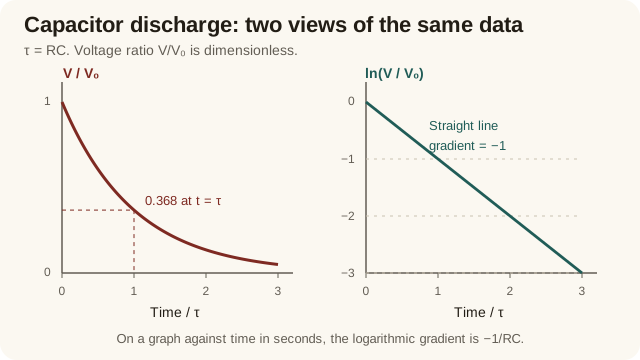
The time constant is τ = RC. At t = τ, voltage and charge have fallen to e⁻¹ = 0.368 of their initial values. For an initial 12 V, locate about 4.4 V on the discharge curve and read its time coordinate. Reading the time to fall by 37%, instead of to 37%, gives a different and incorrect estimate.
Another method is to draw the tangent at the start of the discharge. Its intersection with the time axis occurs at τ for the ideal exponential model. A tangent is a local straight-line approximation; the actual curve does not reach zero at that time. Use a sufficiently large graph and show how the tangent was constructed if using this method.
Carry one example from charge to current
A 100 μF capacitor charged to 12 V discharges through 220 kΩ. Convert the prefixes before multiplying: τ = (100 × 10⁻⁶)(220 × 10³) = 22 s. The initial charge is Q₀ = CV₀ = 1.2 × 10⁻³ C, and the initial current magnitude is V₀/R = 5.45 × 10⁻⁵ A, or 54.5 μA.
After 22 s, voltage is 12/e = 4.41 V and current magnitude is 54.5/e = 20.1 μA. Both are reduced by the same factor because R remains constant. Check the answer against the physical process: the discharge voltage and current magnitude should be smaller than their initial values, with the same sign convention maintained throughout.
Extract capacitance from a logarithmic graph
Divide the discharge equation by V₀ and take natural logarithms: ln(V/V₀) = −t/RC. Plotting the dimensionless logarithm against time gives a straight line through zero for the ideal data. Its gradient has units s⁻¹. If the gradient is −0.0455 s⁻¹, the time constant is 1/0.0455 = 22.0 s.
With R = 220 kΩ, C = 22.0/(220 × 10³) = 1.00 × 10⁻⁴ F, or 100 μF. If a question instead plots ln(V measured in volts), the intercept represents the initial voltage through its logarithm, but the gradient is unchanged. Do not take the reciprocal of the intercept or drop the negative sign without explaining that capacitance is positive.
Keep energy decay separate from voltage decay
Stored energy is W = ½CV². The initial energy in the example is ½ × 100 × 10⁻⁶ × 12² = 7.2 × 10⁻³ J. After one time constant, voltage has the factor e⁻¹, so energy has the factor e⁻² = 0.135. The remaining energy is approximately 0.974 mJ, not 37% of the starting value.
For the ideal discharge, the decrease in stored energy is transferred to thermal energy in the resistor. The instantaneous transfer rate is P = V²/R, so it also falls with the squared voltage. A claim that the capacitor loses equal amounts of energy in equal time intervals is inconsistent with the changing voltage and current.
Practise a half-voltage time and justify the model
How long does the example take to reach 6.0 V? Set ½ = e^(−t/22). Taking natural logarithms gives t = 22 ln 2 = 15.2 s. The time constant is therefore not the half-voltage time. If the resistor is doubled while C stays fixed, both τ and the half-voltage time double, but the initial current halves.
For an experimental check, plot the logarithm of several positive voltage readings rather than relying on a single pair. A roughly straight trend supports exponential behaviour over the measured range. Measurements close to the instrument's resolution limit can give large relative uncertainty after taking logarithms. Identify that limitation before interpreting small departures as evidence that the underlying capacitor law is wrong.
Questions, explained
Choose a question for a direct answer, then explore the explanation and supporting resources. Each answer has its own link to save or share.
Is a capacitor's time constant the time taken for its voltage to halve?
No. For ideal discharge, one time constant leaves V₀/e, approximately 37% of the initial voltage. The half-voltage time is RC ln 2, approximately 0.693RC. Both increase in proportion to resistance or capacitance, but they represent different points on the same curve. Always check whether the question asks for a remaining fraction or a fraction lost.
How do I find capacitance from a ln(V/V₀) graph?
If time in seconds is on the horizontal axis, the gradient is −1/RC. Find its magnitude using a large triangle on the best-fit line, then use C = 1/(R × |gradient|). Convert the resistance into ohms. The gradient's unit is s⁻¹, and the resulting capacitance is in farads; convert to microfarads only after completing the calculation.
Why does capacitor energy fall faster than charge during discharge?
For constant capacitance, stored energy is Q²/(2C), so its fraction remaining is the square of the charge fraction remaining. When charge has fallen to one half, energy has fallen to one quarter. Likewise, after one time constant charge is about 37% of its initial value while energy is about 14%. The energy difference is transferred to the surroundings through the discharge circuit.