Mechanics · 26 September 2026 · 6 min read
M1 forces, friction and connected particles: from diagram to two equations
A connected-particle question becomes manageable when each equation belongs to one clearly identified body. The temptation to put every force into one line creates sign mistakes and unexplained cancellations. Start with the physical model and let the algebra follow.
The worked situations below are original examples for Edexcel IAL Mathematics M1. They explain the decisions behind a force equation; they are not copied examination questions or a claim that every pulley arrangement uses the same assumptions.
Draw forces on the body, not forces exerted by the body
For a block on a horizontal table, its weight acts down and the table’s normal reaction acts up. A horizontal string pulls along its own direction. If the block slides, friction acts opposite its motion relative to the surface. Do not add an extra ‘ma force’: ma is the resultant required by the acceleration, not an additional physical interaction.
An action–reaction pair acts on different bodies. The downward force that the block exerts on the table does not belong on the block’s own diagram. Label each force by its source if you are uncertain. This prevents apparently balanced pairs from being added to a diagram where they do not belong.
Decide which friction statement applies
For a 2 kg block on a horizontal surface with no other vertical force, vertical equilibrium gives R = 2g = 19.6 N when g = 9.8 m/s². If μ = 0.25, the limiting friction is μR = 4.9 N. A horizontal pull of 3 N can be balanced by 3 N of friction while the block stays at rest. Using 4.9 N automatically would invent a resultant force that the equilibrium condition does not have.
If the block is sliding and the model specifies the same coefficient, use friction magnitude μR. If the block is just about to slip, the limiting value also applies. An angled pull can change R, so do not carry R = mg into every diagram. Resolve perpendicular to the contact surface first and establish whether acceleration in that direction is zero.
Set up an original connected-particle example
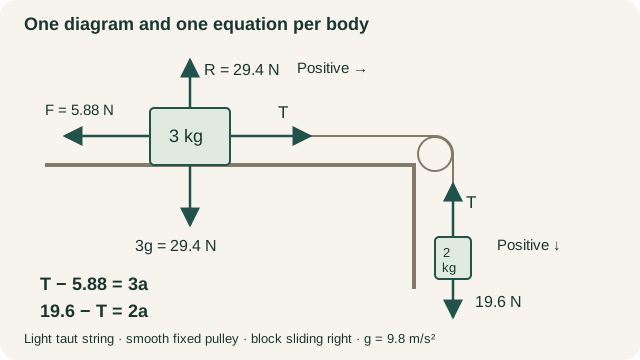
A 3 kg block lies on a rough horizontal table with coefficient of friction 0.20. It is connected to a hanging 2 kg particle by a light, taut, inextensible string passing over a smooth fixed pulley. The system is moving with the hanging particle descending. Use g = 9.8 m/s² and neglect air resistance. Find the acceleration and tension while this model remains valid.
For the block, R = 3g = 29.4 N, so sliding friction is 0.20 × 29.4 = 5.88 N. The ideal string-and-pulley model gives equal tension magnitudes, and the taut inextensible string gives equal acceleration magnitudes along the two parts of the path. Choose right as positive for the block and down as positive for the hanging particle. Those choices follow the same allowed motion.
Solve the two equations and check the result
The block’s horizontal equation is T − 5.88 = 3a. The hanging particle’s vertical equation is 19.6 − T = 2a. Adding them eliminates T: 13.72 = 5a, giving a = 2.744 m/s², or 2.74 m/s² to three significant figures. Substitution gives T = 3 × 2.744 + 5.88 = 14.112 N, or 14.1 N.
Check the second body: 19.6 − 14.112 = 5.488 N, which equals 2 × 2.744. The tension is less than the hanging weight because the hanging particle accelerates downwards; the net downward force is not zero. Adding the two equations works because the compatible internal tensions cancel. You still need an individual-body equation to recover the tension.
Correct the mistakes that produce plausible numbers
Using T = 19.6 N would assume the hanging particle has zero resultant force. That is inconsistent with its downward acceleration. Using 19.6 − 5.88 = 2a would include the friction on the table block while keeping only the hanging mass on the right. If you combine both bodies into one equation along their permitted motion, both masses must contribute.
A negative solved acceleration is not automatically an algebra error: it means the acceleration points opposite your chosen positive direction. But a friction direction that was chosen from an assumed sliding motion must still match that motion. Do not reverse friction solely because acceleration is negative; an object can move one way while accelerating the other way.
Redraw the model whenever the conditions change
If the hanging particle reaches the ground, the previous pair of equations no longer describes the entire subsequent motion. Establish whether the string remains taut and which forces still act. A string can pull but cannot push. If it becomes slack, its tension is zero, and the remaining moving body must be analysed under its new forces.
To practise independently, change the original table to smooth while keeping the two masses. The equations become T = 3a and 19.6 − T = 2a, giving a = 3.92 m/s² and T = 11.76 N. Explain before calculating why the acceleration should increase. For a harder follow-up, change one modelling assumption and describe which line must change before you attempt any algebra.
Finish by writing the model, two force equations, one numerical check and one condition that would end the model’s validity. If the setup remains unclear, take those four items to your teacher or to an online M1 session. Feedback is most useful when the missing decision is visible.
Questions, explained
Choose a question for a direct answer, then explore the explanation and supporting resources. Each answer has its own link to save or share.
Is friction always equal to μR in M1?
No. In equilibrium, friction can take the value needed up to the limiting value μR. Equality applies at limiting equilibrium and, under the standard sliding-friction model, during sliding. Find the normal reaction from the actual force diagram before using the coefficient of friction.
Why is tension not equal to the hanging weight?
Equal tension and weight would give zero resultant force on that hanging particle. If it accelerates downward, weight is greater than tension; if it accelerates upward, tension is greater. Write the signed force equation for that particle instead of assuming equality.
Why do connected particles have the same acceleration?
In the simple fixed-pulley model with a taut inextensible string, movement of one end constrains the other end by the same length. The acceleration magnitudes therefore match along their paths, although their directions differ. This conclusion should not be transferred automatically to slack strings, elastic strings or different pulley arrangements.
Which direction does friction act in a mechanics question?
Sliding friction opposes relative motion at the contact. Static friction opposes the tendency for relative slipping. It does not always oppose acceleration: a sliding object can slow down while friction and acceleration point in the same direction.