Exam technique · 26 September 2026 · 7 min read
How to answer unfamiliar Physics questions when you do not recognise the context
A question about an unfamiliar device can feel like a topic you never studied. Often, the new name is only the setting: the task still uses force, energy, waves, electricity or another familiar relationship. The challenge is selecting and connecting the ideas without a chapter heading telling you the route.
The examples below are original teaching questions. They illustrate a method for IGCSE and A-Level Physics, with an A-Level extension marked separately. They are not predictions about future papers or a promise that one fixed template answers every question.
Translate the question into a quantity and a model
Start with the final instruction. Does it ask for a force, an energy, a reason, a comparison or an evaluation? Write that target beside the data. Then draw only the part of the system that matters. A delivery robot, a trolley and a moving platform can all be represented as a body with forces acting on it, provided the assumptions justify that simplification.
Read the details you initially dismissed. ‘Constant speed’ can establish zero resultant force in straight-line motion; ‘negligible resistance’ can simplify an energy balance; ‘steady output’ may permit a constant-power calculation. These phrases set conditions. They do not merely decorate the story, and changing one can change the entire solution.
Example one: a new machine with familiar forces
An inspection robot of mass 40 kg moves horizontally. Its drive provides a forward force of 70 N and resistance is 22 N. Find its acceleration. You do not need to know how the robot’s motor is constructed. For horizontal motion, the resultant force is 70 − 22 = 48 N, so a = F/m = 48/40 = 1.2 m/s² forward.
A tempting incorrect answer uses 70/40 = 1.75 m/s². The arithmetic works, but it treats the driving force as the resultant. Correct the model by drawing the two opposite horizontal arrows. Then change the question: if the robot moves at constant velocity on the same horizontal path, what drive force balances a 22 N resistance? The answer is 22 N, because the resultant is zero.
Example two: build a chain when one equation is not enough
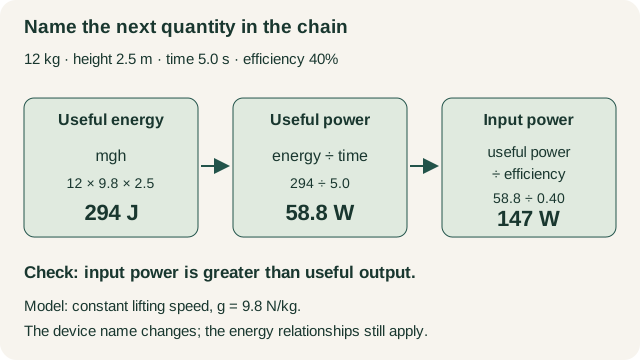
A device lifts a 12 kg load vertically through 2.5 m in 5.0 s at constant speed. Its overall efficiency is 40%, and g = 9.8 N/kg. Find the average input power for that lift. Begin with useful energy: the increase in gravitational potential energy is mgh = 12 × 9.8 × 2.5 = 294 J. The useful average power is 294/5.0 = 58.8 W.
Efficiency = useful output power/input power, so input power = 58.8/0.40 = 147 W. Multiplying by 0.40 would make the input smaller than the useful output, which contradicts this energy-transfer model. The problem has three linked decisions: identify the useful energy change, convert it to a rate, and use the efficiency in the correct direction.
A-Level extension: derive the route before substituting numbers
For a load rising at constant vertical speed v in the same idealised useful-output model, useful power is mgh/t. Since h/t = v, this becomes P(useful) = mgv. With efficiency η expressed as a fraction, P(input) = mgv/η. Deriving this expression explains the connections rather than adding another isolated formula to memorise.
Now test its conditions. If the load accelerates, a change in kinetic energy may also contribute to the useful energy transfer over an interval. If the question defines efficiency differently, use that definition. The derived expression is not a licence to ignore the model: it is a compact summary of the assumptions you made.
Use the same discipline for explanations
Suppose a question describes a sensor containing a wire whose resistance increases as it gets hotter. You may not recognise the sensor’s commercial name, but the supplied relationship is enough for some comparisons. If a constant potential difference is maintained across that wire, I = V/R predicts a smaller current as resistance rises. State the constant-voltage condition; without it, the same conclusion need not follow.
A clear answer names the changed quantity, the relationship and the consequence. Avoid repeating the question in different words, such as ‘the sensor changes because it is hotter’. If asked to evaluate a proposed design, distinguish what the evidence supports from what additional data you would need. A convincing explanation should respond to the command word, not simply display every fact you remember about the topic.
When you get stuck, leave a useful trail of reasoning
Write a relevant diagram, equation or intermediate result, even if you cannot finish the full chain. Credit depends on the particular marking scheme, so no isolated phrase guarantees marks. Nevertheless, clear working records your reasoning and gives you a better chance of recovering the next step than a blank page or a list of unrelated equations.
During revision, compare the first point where your route differs from the solution. Did you miss a condition, choose the wrong body, fail to identify an intermediate quantity, or make an algebra error? Create a follow-up question that changes one feature. In the lifting example, halve the time while keeping mass, height and efficiency unchanged: the required average input power doubles to 294 W. Explain that prediction before calculating.
Finally, practise with the topic label removed and describe why your method fits. You are ready to move on when you can explain both the correct choice and one tempting wrong choice. If that decision remains difficult, a teacher can use your unfinished attempt to target the missing connection. The revision-session builder links the next practice task to your course and the obstacle you are working on.
Questions, explained
Choose a question for a direct answer, then explore the explanation and supporting resources. Each answer has its own link to save or share.
How do I answer a Physics question about something I have never heard of?
Use the description to identify the quantities, conditions and requested answer. Replace the unfamiliar device with a simple model, such as a body with forces or an energy-transfer system. Apply familiar relationships and use any new information supplied in the question rather than assuming you must already know the device.
Why do I understand Physics notes but struggle with exam questions?
Notes usually present the topic and method together. A question may require you to choose the model, recognise a condition and connect several steps yourself. Practise those decisions explicitly: draw a diagram, name an intermediate quantity and justify the first equation before completing the calculation.
How do I approach a multi-step Physics calculation?
Write the target quantity and work backwards to the quantities needed to find it. Then calculate forward through the chain, keeping units at each step. For a lifting device, useful energy can lead to useful power, which combines with efficiency to give input power.
What should I do if I cannot finish a Physics exam question?
Record a relevant diagram, relationship or intermediate result clearly, then manage your remaining time and return if possible. The marks available depend on the question’s scheme; avoid assuming that any formula earns credit. During revision, use the unfinished step to identify the exact reasoning skill to practise.