Mechanics · 26 September 2026 · 6 min read
M1 SUVAT and motion graphs: choose the interval, signs and equation
Knowing five motion equations is only the beginning. In M1, the decisive choices are often which interval an equation describes, whether a quantity is signed, and whether a motion condition has changed. A single sketch can prevent a correct equation being used for the wrong stage.
This guide uses original constant-acceleration examples for Edexcel IAL Mathematics M1. The methods also support school Physics, but a resource labelled ‘mechanics’ may include topics beyond M1. Keep your official unit specification beside your revision checklist.
Choose a time interval before choosing a formula
SUVAT describes motion with constant acceleration over the chosen interval. The symbols represent displacement s, initial velocity u, final velocity v, acceleration a and elapsed time t. ‘Initial’ means the start of that interval, not necessarily the beginning of the entire story. If a particle accelerates, cruises and then brakes, make a separate record for each stage.
A convenient equation contains the unknown you need and the quantities you know. If time is not given or needed, v² = u² + 2as can connect speed change with displacement. If displacement is unnecessary, v = u + at may be enough. Do not collect all five formulae on the page and hope that one accepts the available numbers.
Use a stopping example to test your signs
A particle moves right at 12 m/s and has constant acceleration 3 m/s² left until it stops. Take right as positive: u = +12, a = −3 and v = 0. From v = u + at, the stopping time is t = 4 s. From v² = u² + 2as, 0 = 144 − 6s, giving s = 24 m to the right.
A common error is to insert a = +3 because the question gives an acceleration magnitude of 3. That would describe speeding up to the right, not slowing down. Another is to make u negative merely because the particle will eventually stop. Choose directions from the motion described, then use one convention consistently in every equation for that stage.
Distinguish displacement from distance when motion reverses
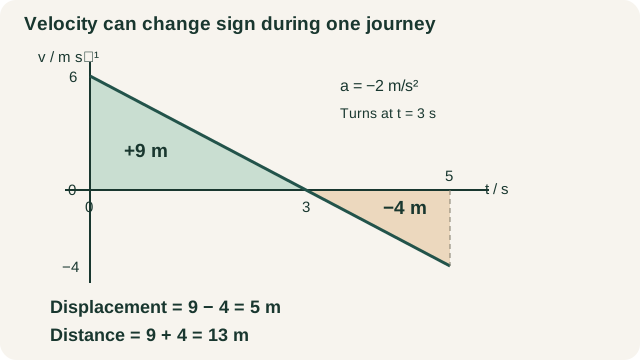
Now consider a different model: a particle starts with velocity +6 m/s and continues with constant acceleration −2 m/s² for 5 s. It reaches rest after 3 s and then moves in the negative direction. Its final velocity is −4 m/s. SUVAT gives the displacement over all 5 s as s = 6 × 5 + ½ × (−2) × 5² = 5 m.
The total distance is different. Before the turning point, the particle travels 9 m in the positive direction. During the final 2 s it travels 4 m back. Distance is 9 + 4 = 13 m; displacement is 9 − 4 = 5 m. An answer of 5 m to a total-distance question would ignore part of the journey even though the SUVAT substitution was correct.
Read a motion graph through its units
For a velocity–time graph, gradient has units (m/s)/s = m/s², so it describes acceleration. Area has units (m/s) × s = m, so it describes displacement. A line below the time axis shows negative velocity, not necessarily decreasing speed. In the example, speed increases after 3 s even though the velocity becomes more negative.
For a displacement–time graph, gradient gives velocity. For a speed–time graph, area gives distance because speed is non-negative. Do not use the memorised phrase ‘area gives distance’ without reading the vertical-axis label. In a problem with direction changes, that small label determines whether signed areas must cancel or their magnitudes must be added.
Join stages using the correct boundary values
Suppose a trolley starts from rest, accelerates uniformly at 2 m/s² for 3 s, then moves at constant velocity for 4 s. Stage one ends at 6 m/s and covers 9 m. Stage two begins at 6 m/s, has zero acceleration and covers 24 m. Total time is 7 s and total displacement is 33 m. The first stage’s final velocity becomes the second stage’s initial velocity.
You cannot use a = 2 m/s² over all 7 s, because that acceleration ends after 3 s. A velocity–time sketch makes the mistake visible: the rising section is followed by a horizontal section. If a later stage begins after impact, a release or a string becoming slack, identify the new conditions instead of assuming every quantity transfers unchanged.
Check a vertical-motion answer without changing gravity halfway
For vertical motion near Earth in a model neglecting air resistance, choose upward positive and use a = −g throughout ascent and descent. At the highest point, vertical velocity is zero at an instant; acceleration remains downward. Changing acceleration to zero at the top would describe a different model.
Before finishing any motion question, check the units, the sign and the interval. Does the time lie within the stage being modelled? Did the particle reverse before the endpoint? Does a squared-velocity equation leave a direction choice that still needs the context? If you obtain two mathematical times, decide which correspond to the event described instead of discarding one without explanation.
For an independent retry, use u = +8 m/s, a = −2 m/s² and t = 6 s. The turning time is 4 s, final velocity is −4 m/s, displacement is 12 m and distance is 20 m. Explain all four answers from a sketch. That explanation tests the model more thoroughly than merely reproducing a formula.
Questions, explained
Choose a question for a direct answer, then explore the explanation and supporting resources. Each answer has its own link to save or share.
How do I know which SUVAT equation to use?
List s, u, v, a and t for one constant-acceleration interval. Mark what you know and what you need. Choose an equation containing the required quantity while excluding an unnecessary unknown; for example, v² = u² + 2as is useful when time is not involved.
Does negative acceleration always mean an object is slowing down?
No. Negative acceleration indicates a direction relative to your chosen axis. If velocity is positive, negative acceleration reduces speed until the turning point. If both velocity and acceleration are negative, the speed increases in the negative direction.
Does SUVAT give distance or displacement?
The s in SUVAT is displacement. If the particle reverses direction, split the motion at the turning point and add the magnitudes of the stage displacements to find total distance. Without a reversal, distance is the magnitude of displacement for that interval.
Is acceleration zero when velocity is zero?
Not necessarily. A vertically thrown particle has zero velocity at its highest point while gravitational acceleration still acts downward in the usual model. A velocity–time graph can cross zero with a nonzero gradient, so zero velocity alone does not establish zero acceleration.