IGCSE · 26 September 2026 · 6 min read
Wave speed, frequency and wavelength: IGCSE worked questions
The equation v = fλ is short, but wave questions often test whether you have identified the right quantity before using it. A horizontal separation on a graph might be a wavelength in metres or a period in seconds. Multiplying every pair of numbers on the page cannot distinguish them.
The original examples below build a reliable method: identify the wave and medium, read the axes, establish the relationship, convert units and predict the direction of change. The method supports Cambridge and Edexcel IGCSE work, with individual content requirements checked against your specification.
Read the graph before choosing an equation
A displacement–distance graph is a snapshot of the wave along space. The distance between adjacent crests is one wavelength. A displacement–time graph shows what happens at one position over time; the interval between adjacent crests is one period. Similar-looking curves can therefore provide different information.
Measure between points in the same stage of the cycle, such as crest to next crest. Crest to trough is half a cycle. The vertical maximum displacement is amplitude, not wavelength or period. Write the units beside each reading before calculating: metres identify a length, while seconds identify a time.
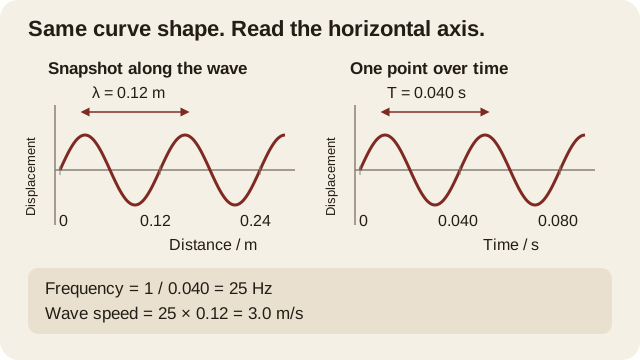
Worked example: speed from frequency and wavelength
A wave has frequency 25 Hz and wavelength 12 cm. Convert 12 cm to 0.12 m, then use v = fλ = 25 × 0.12 = 3.0 m/s. The units make sense: cycles per second multiplied by metres per cycle gives metres per second. Keeping 12 as though it were metres would produce a hundredfold error.
Change the source frequency to 50 Hz while the wave speed remains 3.0 m/s in the same stated conditions. The wavelength becomes λ = v / f = 3.0 / 50 = 0.060 m, or 6.0 cm. Doubling frequency halves wavelength here; it does not automatically double the speed. State the fixed-speed condition when explaining that inverse relationship.
Worked example: a time graph and period
At one point on a medium, successive wave crests pass at 0.010 s and 0.030 s. The period is their separation, 0.020 s, so f = 1 / T = 50 Hz. If the wave speed is 4.0 m/s, the wavelength is 4.0 / 50 = 0.080 m. A time separation cannot be inserted directly as a wavelength.
Suppose you can measure across five full cycles instead. A total interval of 0.100 s still gives T = 0.100 / 5 = 0.020 s. Measuring several cycles can make the relative reading uncertainty smaller. Count the intervals rather than the visible crest points: six successive crests enclose five complete periods.
Worked example: crossing into a different medium
Water waves approach a stationary boundary with frequency 8.0 Hz and speed 0.40 m/s. Their initial wavelength is 0.40 / 8.0 = 0.050 m. In the second region the speed is 0.24 m/s. The frequency remains 8.0 Hz, so the new wavelength is 0.24 / 8.0 = 0.030 m.
The source continues producing the same number of wave cycles each second; the shorter distance travelled per second compresses their spacing. Do not claim the frequency falls because the waves slow down. If the boundary is approached obliquely, the direction can also change, but the calculation above concerns speed and spacing, not an angle measurement.
Separate wave properties from the movement of the medium
In a transverse wave, oscillations are perpendicular to the direction of energy transfer. A point on a string moves up and down while the disturbance travels along it. The wave speed describes the propagation of that disturbance, not the instantaneous speed of one marked point on the string.
For sound, particles oscillate about their positions as the disturbance travels through the medium. Frequency relates to pitch; amplitude relates to the size of the oscillation and is associated with loudness under comparable conditions. Increasing amplitude is not the same operation as increasing frequency. Identify which feature of the graph actually changes.
Independent practice: calculate and predict first
A sound wave of frequency 680 Hz travels at 340 m/s in the stated conditions. Its wavelength is 340 / 680 = 0.50 m and its period is 1 / 680 ≈ 1.47 × 10⁻³ s. Now reduce frequency to 340 Hz while keeping wave speed fixed. Predict before calculating: wavelength doubles to 1.0 m and period doubles to about 2.94 × 10⁻³ s.
If you obtained a smaller wavelength, check whether you multiplied instead of dividing. If your period is hundreds of seconds, check the reciprocal and the time unit. Finish each revision example by changing one quantity and naming what stays constant. This tests whether you understand the relationship rather than only remember the letters in the equation.
Questions, explained
Choose a question for a direct answer, then explore the explanation and supporting resources. Each answer has its own link to save or share.
Does frequency change when a wave enters a new medium?
At a stationary boundary, frequency remains set by the source. If wave speed changes, wavelength changes so that v = fλ remains true. Do not assume slower travel means fewer oscillations per second at the boundary.
How do I tell whether a graph shows wavelength or period?
Read the horizontal axis. A displacement–distance graph gives wavelength from the distance between equivalent points on successive cycles. A displacement–time graph gives period from their time separation. The vertical axis gives displacement, so the maximum displacement is amplitude.
How do I calculate period from frequency?
Use T = 1/f, with frequency in hertz to obtain period in seconds. For 50 Hz, one cycle lasts 1/50 = 0.020 s. Convert units if the answer is requested in milliseconds and avoid confusing the time for many cycles with one period.
Does increasing frequency increase wave speed?
Not automatically. If the wave speed is fixed by the stated medium and conditions, increasing frequency reduces wavelength. Use the assumptions supplied by the question. A higher source frequency by itself is not a reason to double the propagation speed.
What is the difference between amplitude and wavelength?
Amplitude is the maximum displacement from equilibrium. Wavelength is the distance between equivalent points on adjacent cycles. On a transverse-wave snapshot, amplitude is a vertical measurement while wavelength is a horizontal one; the two describe different properties.