IGCSE · 26 September 2026 · 6 min read
Refraction and total internal reflection: IGCSE worked questions
A refraction calculation can be numerically correct but physically wrong if the angle was measured from the surface. A total-internal-reflection answer can use the right critical angle but the wrong travel direction. Sketching the boundary and normal prevents both errors.
These original worked questions focus on interpreting ray geometry and checking calculations. Refraction depth varies across IGCSE routes, so match the quantitative detail to your board and tier. The explanations use air as approximately refractive index 1 where stated.
Draw three things before touching the calculator
Draw the boundary, a normal at the point where the ray meets it, and an arrow showing the ray's direction. The normal is perpendicular to the surface. Label the incident and refracted angles between their rays and the normal, not between the rays and the surface.
If a diagram gives 30° to the surface, the corresponding angle to the normal is 60°. That conversion must happen before applying a refraction equation. Check which material the ray starts in and which it enters. The same glass block can give bending towards the normal on entry and away from it on exit.
Worked example: finding refractive index
A ray travels from air into a transparent material with angle of incidence 45° and refraction 28°, both measured from the normal. Using n = sin i / sin r for this air-to-material situation gives n = sin 45° / sin 28° ≈ 1.51. Set the calculator to degrees. Refractive index has no unit because it is a ratio.
The result is consistent with the geometry: the refracted angle is smaller, so the ray bends towards the normal. Dividing 45 by 28 is not the same calculation as dividing their sines. A value below 1 for this ordinary air-to-glass-style example would signal an inverted ratio, wrong angle reading or another setup error.
Worked example: finding the angle in glass
Light enters glass of refractive index 1.50 from air at 30° to the normal. Rearrange to sin r = sin 30° / 1.50 = 0.333..., then use inverse sine to obtain r ≈ 19.5°. Do not report 0.333°: that is the sine value, not the angle. Draw the refracted ray closer to the normal to match the calculation.
Change the incident angle to 0°. The ray enters along the normal and continues without changing direction, even though its speed and wavelength change at the boundary. Refraction is associated with the speed change; bending is absent for this particular geometry. This is why always bends is an incomplete general statement.
Worked example: test both conditions for total internal reflection
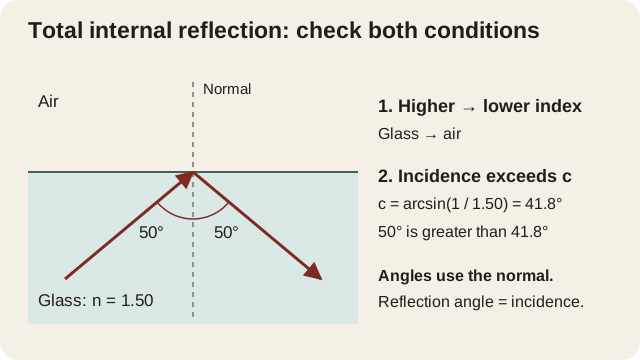
For glass of refractive index 1.50 adjoining air, sin c = 1 / 1.50 gives c ≈ 41.8°. A ray travelling inside the glass towards air at 50° to the normal exceeds the critical angle, so total internal reflection occurs. At 35° it does not: a refracted ray can leave into the air.
Now reverse the travel direction so the ray comes from air into glass at 50°. It does not undergo total internal reflection at that boundary. The required higher-to-lower-index condition fails. Checking only whether 50 is bigger than 41.8 would therefore give a wrong answer despite apparently correct arithmetic.
Explain the critical angle and an optical fibre clearly
At the critical angle, the refracted ray lies along the boundary, at 90° to the normal. Total internal reflection occurs for incidence angles greater than this value, not merely equal to it. Distinguish the incident angle inside the higher-index material from the refracted angle outside it.
An optical fibre can guide light by repeated total internal reflection at a suitable core boundary. State the index relationship and angle condition rather than describing the wall as an ordinary mirror. A bend or changed ray direction can alter incidence angles, so the condition must remain satisfied; saying all light is trapped forever is too broad.
Independent practice and a ray-diagram check
A material has refractive index 1.60 against air. Calculate c = sin⁻¹(1/1.60) ≈ 38.7°. A ray inside it reaches the boundary at 40° to the normal, so total internal reflection occurs. If instead the diagram labels 40° to the surface, the incidence angle is 50°; the conclusion is the same here, but the reasoning and stated angle must change.
Finish by drawing the reflected ray with reflection angle equal to incidence angle. If no total internal reflection occurs, add a refracted ray on the correct side and with the correct direction of bending. Log whether a wrong answer came from direction, geometry, algebra or calculator mode. Those errors require different fixes, even when all produce a wrong number.
Questions, explained
Choose a question for a direct answer, then explore the explanation and supporting resources. Each answer has its own link to save or share.
What are the two conditions for total internal reflection?
The ray must travel towards a medium with lower refractive index, and its angle of incidence in the higher-index medium must exceed the critical angle. Measure incidence from the normal. An angle above a memorised value is insufficient if the ray is travelling in the wrong direction.
How do I calculate the critical angle?
For a medium of refractive index n adjoining air, use sin c = 1/n and then inverse sine. For n = 1.50, c is about 41.8°. This form assumes air has refractive index approximately 1; it is not the general formula for every pair of materials.
Are refraction angles measured from the normal or the surface?
From the normal, which is perpendicular to the boundary. If the diagram gives an angle to the surface, subtract it from 90° before using it as incidence or refraction. Draw and label the normal first to avoid this common error.
Does total internal reflection happen at the critical angle?
At the critical angle, the refracted ray runs along the boundary. Total internal reflection occurs when the incidence angle is greater than the critical angle, provided the ray travels towards the lower-index medium. Keep equality and greater-than cases distinct.
Why does light not bend when it enters along the normal?
At normal incidence the ray is perpendicular to the boundary, so its direction remains unchanged. Its speed and wavelength can still change in the new medium while frequency stays the same. A speed change does not require a direction change in this special geometry.