Revision methods · 26 September 2026 · 6 min read
How to check Physics calculation answers: units, scale and physical meaning
The most powerful calculation check is often a different line of reasoning from the one that produced the answer. If you use the same calculator entry twice, you may reproduce the same misplaced bracket twice. Physics gives you additional tests because an answer must describe a meaningful relationship between quantities.
This guide develops a checking routine through original examples. Use the checks that fit the question and your course: dimensional analysis becomes more formal at A-Level, while units, estimates and sensible trends are useful from the start of IGCSE.
Ask what quantity the result is supposed to represent
Before checking arithmetic, reread the final instruction. Are you finding total resistance or the resistance of one component? Is the question asking for distance, displacement, speed or velocity? A technically correct calculation of the wrong quantity still fails the task. Circle or underline the requested quantity and include it in the final sentence or answer label.
For a journey returning to its starting point, displacement can be zero while total distance is positive. That distinction cannot be repaired by changing a unit. Similarly, the resultant force is not necessarily the largest individual force acting on an object. Identify the system and quantity first, because every later numerical check depends on using the right physical interpretation.
Check units through the equation
If average power is P = E/t, joules divided by seconds give watts. If your rearrangement instead multiplies energy by time, the result has units J s and cannot represent power. For density, mass divided by volume gives kg/m³ in SI units. The unit relationship can expose an algebra error before you enter any numbers.
At A-Level, you can expand derived units into base units to test dimensional consistency. Remember the limitation: a dimensionally consistent expression is not necessarily physically correct. Multiplying a correct equation by an incorrect dimensionless factor preserves its units. Unit checks eliminate some mistakes, but you still need the right model, constants and interpretation.
Estimate the scale before trusting the calculator
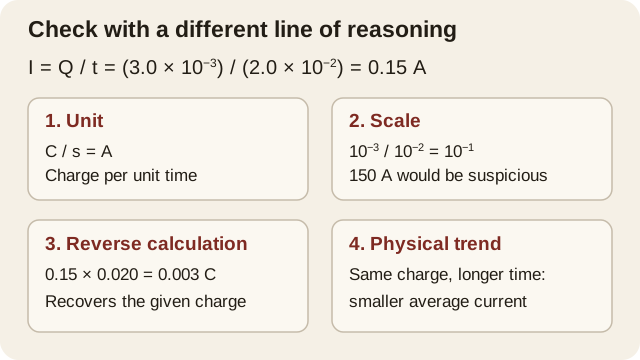
Consider 3.0 × 10⁻³ C transferred in 2.0 × 10⁻² s. Current is 0.15 A. Dividing the powers of ten separately gives 10⁻¹, so an answer of 150 A is immediately suspicious. Estimate with one significant figure if necessary; the aim is to distinguish a plausible order of magnitude from a conversion or entry error.
For a more everyday example, a runner covering 100 m in roughly ten seconds has an average speed around ten metres per second. An answer of 0.01 m/s cannot describe that data. Estimates are not substitutes for a final calculation, and unfamiliar microscopic or astronomical quantities may require reference values. Even then, comparing powers of ten can reveal many mistakes.
Substitute back or calculate the quantity another way
If you rearranged V = IR to find R, substitute the calculated resistance back into the original relationship with the given current. For V = 12 V and I = 0.50 A, R = 24 Ω; checking IR gives 12 V. A result of 6 Ω fails this reverse check because it would give only 3 V under the stated conditions.
Where possible, compare with an independent relationship. In a suitable electrical model, calculate power from VI and from I²R using consistent quantities. Agreement does not prove every assumption is correct, but disagreement identifies something to inspect. Avoid calling a check independent if it merely repeats the same rearranged expression with the same mistaken input.
Test signs, directions and limiting behaviour
A negative velocity can be meaningful when it indicates motion opposite to the chosen positive direction. A negative speed is not an acceptable final description. State your sign convention in directional problems and check whether the calculated sign matches the motion or force diagram. Do not remove a minus sign merely because it looks inconvenient.
Now change an input mentally. At fixed mass, doubling the resultant force doubles acceleration in the Newtonian model F = ma. At fixed voltage, increasing resistance reduces current. If your expression predicts the opposite, inspect the algebra or the controlled condition. At A-Level, a limiting case such as a very large resistance can be a particularly useful test, provided that the underlying model remains valid.
Use a final check that matches the error risk
Make a compact finishing routine: requested quantity, unit, scale and one physical comparison. For a multi-stage calculation, also check that intermediate values retained enough precision and that the final rounding follows the task. In a graph question, confirm the axis scale, units and interval used. The best check is the one most likely to expose the particular mistake you could have made.
Record recurring failures in an error log. If squared-unit conversion causes trouble, practise converting an area before substituting rather than adding a generic “check units” reminder. If the model choice is repeatedly wrong, further arithmetic checking will not solve it. Bring a worked example to a teacher so the discussion can focus on the first incorrect decision.
Questions, explained
Choose a question for a direct answer, then explore the explanation and supporting resources. Each answer has its own link to save or share.
If my Physics answer has the right units, is it correct?
No. Correct units are a necessary check for a valid equation, but an incorrect numerical factor or a wrong model can still produce the same unit. Also check the requested quantity, magnitude, conditions and physical behaviour of the result.
Can a Physics calculation answer be negative?
Yes, for quantities whose sign represents direction or a defined change, such as velocity or potential difference under a stated convention. Some quantities, including speed and ordinary mass in these school models, should not be negative. Interpret the quantity and sign convention before changing the answer.
Is doing a calculation twice enough to check it?
Repeating the same entry can repeat the same error. Use a different check where possible: estimate the magnitude, inspect units, substitute back into the original equation or compare with an independent relationship. These methods test different parts of the calculation.
What should I do if my Physics answer seems unreasonable?
First check the quantity requested, unit conversions, calculator brackets and powers of ten. Then inspect the physical model and assumptions. Keep a clear method while correcting it; changing the answer to a familiar-looking number without finding the cause does not repair the reasoning.
What is a limiting-case check in Physics?
A limiting-case check asks what your expression predicts when a quantity becomes very small or very large within the model’s valid range. For example, current should decrease as resistance increases at fixed voltage. An implausible trend can expose a wrong rearrangement or assumption.