Revision methods · 25 September 2026 · 6 min read
A physics past-paper error log that turns lost marks into useful practice
An error log should help you decide what to practise next. It should not become a beautifully organised archive that takes longer to maintain than the questions themselves. The most useful entry identifies the decision that failed and gives you a practical way to test whether it has improved.
This guide provides a compact template and an original worked example. It focuses on the feedback stage after a paper, complementing the broader guide to using past papers. A notebook, spreadsheet or a few index cards can all work; the essential feature is a repair-and-retest cycle.
Keep the evidence, not only the final mark
Save the paper reference, question number and your first attempt. If the working is overwritten with the correct answer, it becomes harder to diagnose what you originally thought. Add corrections in a different colour or alongside the attempt. Where marking is uncertain, note the question for a teacher rather than awarding yourself a doubtful mark and moving on.
Log the errors that will change future practice. Five missing unit labels caused by the same habit may need one entry with several references, while two different misunderstandings in the same question may need separate actions. Include answers reached by guessing when your reasoning was not secure. A correct final number is not enough evidence of understanding if the route to it cannot be repeated.
Find the first decision that went wrong
Use categories as prompts, not verdicts: concept, model or equation choice, mathematical manipulation, units, interpretation, practical reasoning, or completion under time. ‘Careless’ is usually too broad. If a student substitutes a diameter into a formula needing radius, the useful description is ‘did not identify the required geometric quantity before substitution’. That points to a check they can practise.
Do not count every later wrong number as a separate weakness when they all follow from one early mistake. Conversely, do not hide a conceptual problem behind arithmetic. Ask the student to explain why the equation applies before recalculating. If that explanation is missing, simply drilling calculator entry is unlikely to repair the main difficulty.
Use a five-field entry with a concrete repair
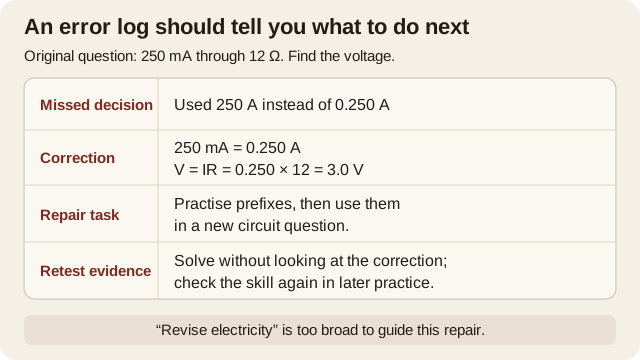
A useful entry has five fields: question reference; first wrong decision; correction in your own words; repair task; retest evidence. For an original example, a current of 250 mA flows through a 12 Ω resistor. The correct conversion is 0.250 A, so V = IR = 3.0 V. A result of 3000 V shows that the milliampere conversion was skipped.
The repair should be more specific than ‘revise electricity’. Write ‘convert three current values between mA and A, then calculate voltage in a fresh resistance question’. The retest should require the same decision with different values or wording. This keeps the log connected to a small, teachable skill while still placing that skill back inside physics.
Separate correction from proof of improvement
Reading a solution can make the method feel obvious. That is useful for learning, but it is not yet evidence that you can choose the method independently. After studying the explanation, close it and reconstruct the reasoning. Then attempt a related question without prompts. If you need the answer open, record the entry as still in progress.
Retest again after some time has passed, using a question that is similar in skill but not identical in surface details. The interval should fit your course and exam timing rather than an inflexible calendar. If the mistake returns, identify whether the repair was too shallow, the new context was harder or the earlier success depended on remembering the original answer.
Choose the next revision task from the pattern
At the end of a week, scan for recurring causes. Several electricity, mechanics and waves errors involving unit prefixes suggest a mathematical skill that crosses topics. Several force questions with incorrect diagrams suggest a modelling problem. These patterns help you choose between targeted skill practice, relearning a topic and a discussion with a teacher.
Consider both importance and repairability. A recurring basic conversion may be quick to address, while a difficult field question may need a longer explanation. Do not chase only the easiest marks or only the hardest topic. Keep coverage of the whole syllabus while using the log to decide where an additional focused session is most useful.
Keep the system small enough to maintain
End a marking session with a few clear next actions, not a complete rewritten textbook. For each action, specify the resource, question type and evidence of success. For example: read the circuit section on potential difference, solve two unfamiliar voltage questions, and explain why the voltmeter is connected in parallel. That is a manageable task with an observable result.
Bring unresolved entries to a lesson or support conversation. A question reference, your attempt and a sentence explaining where you became stuck are much more useful than ‘I do not understand electricity’. Archive entries that stay secure on later mixed practice, but revisit recurring patterns. The log succeeds when it changes how you solve questions, not when every row is marked green.
Questions, explained
Choose a question for a direct answer, then explore the explanation and supporting resources. Each answer has its own link to save or share.
What should I write in a physics error log?
Record the question reference, the first incorrect decision, the correction in your own words, a specific repair task and a retest result. Keep the original attempt so the cause remains visible. A useful entry says what you will do next, such as practising milliampere conversions inside circuit questions, rather than only naming a broad topic like electricity.
Do I need to log every lost mark?
No. Group repeated mistakes with the same cause and prioritise entries that lead to a useful change in practice. Preserve the marked paper for full detail. A compact log is easier to act on than a long transcription of mark schemes, but include uncertain correct answers and guesses when you cannot yet explain the reasoning independently.
How do I know a physics mistake is actually fixed?
Solve a fresh question requiring the same decision without looking at the correction, and explain why your method applies. Check the skill again in later mixed practice. Repeating the original answer immediately after reading it mainly tests short-term familiarity. If the mistake returns, revise the repair task rather than assuming that the student simply needs more identical papers.