Maths for physics · 25 September 2026 · 6 min read
Significant figures and standard form in physics: a calculation workflow
A correct equation can still lead to an answer a thousand times too large when a unit prefix is missed. An otherwise sound calculation can also lose useful precision if rounded too early. These are different problems, so they need separate checks.
This guide gives a repeatable workflow for IGCSE and A-Level calculations, with original examples of significant figures, standard form and unit conversion. It does not impose one rounding rule on every examination. Explicit question instructions and the current specification for your entry take priority.
Count digits that communicate precision
Leading zeros locate the decimal point and are not significant. The value 0.00450 has three significant figures: 4, 5 and the final 0. That last zero communicates the stated precision. Zeros between nonzero digits do count, so 1002 has four significant figures. Decimal places answer a different question: 0.00450 has five decimal places but only three significant figures.
Trailing zeros in a whole number can be ambiguous without context. Writing 1500 does not always show whether the intended precision is two, three or four significant figures. Standard form resolves this: 1.5 × 10³ has two significant figures, while 1.500 × 10³ has four. Keep the precision justified by the measurement or instruction rather than adding zeros merely to make answers look consistent.
Use standard form without changing the value
In normalised standard form, the magnitude of the first factor lies from 1 up to, but not including, 10. Thus 4500 = 4.5 × 10³ and 0.00045 = 4.5 × 10⁻⁴. A positive power of ten represents a large multiplier; a negative power represents division by a power of ten. The exponent moves the decimal place, while the digits retained in the first factor state the precision.
Practise converting in both directions. If a calculator displays 6.2E−3, it means 6.2 × 10⁻³, or 0.0062. Use the calculator’s exponent entry key correctly, and check a simple known value before relying on an unfamiliar device. Writing both a multiplication-by-ten expression and an extra exponent key can accidentally enter the power twice.
Convert the quantity before substituting it
Write the required unit beside each value before entering numbers. A current of 3.0 mA is 3.0 × 10⁻³ A. A resistance of 2.0 kΩ is 2.0 × 10³ Ω. Their product gives V = IR = (3.0 × 10⁻³)(2.0 × 10³) = 6.0 V. The powers cancel, providing a useful check on the calculator answer.
Take particular care with area and volume. Since 1 cm = 10⁻² m, 1 cm² = 10⁻⁴ m² and 1 cm³ = 10⁻⁶ m³. The conversion factor must be squared or cubed along with the unit. For example, 25 cm² = 0.0025 m². Dividing by 100 instead of 10,000 is an area-conversion error, not a rounding error, and changing significant figures cannot repair it.
Keep working digits and round at the final step
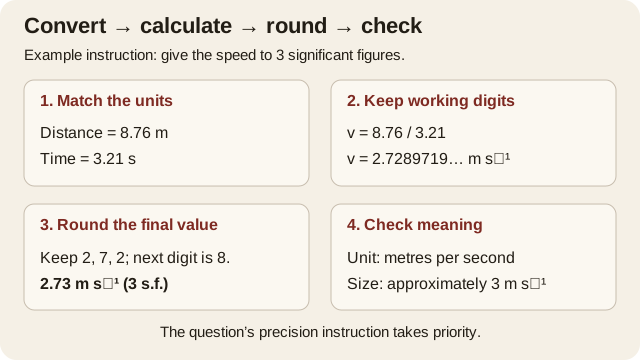
Suppose a fictional calculation gives a speed of 8.76/3.21 = 2.7289719… m s⁻¹. If the required result is three significant figures, report 2.73 m s⁻¹. Retain the calculator value if it is needed in a later step, such as squaring the speed. Replacing it prematurely with 2.7 can introduce unnecessary rounding error into the final result.
Exact counts and defined conversion factors are not measurements with the same uncertainty as the raw data. Dividing a timed total by exactly ten oscillations does not automatically restrict the answer to one significant figure. For Cambridge 0625 practical presentation, the syllabus gives specific guidance on calculated quantities and raw-data precision. Other tasks may specify their own rule; do not replace those instructions with ‘always use three significant figures’.
Round the value, not just the written digits
To round 0.006784 to two significant figures, keep 6 and 7, inspect the next digit 8, and increase the 7 to 8. The result is 0.0068. To round 9.96 to two significant figures, the carry gives 10; writing 1.0 × 10¹ makes those two significant figures explicit. A number can change its apparent decimal length when correctly rounded.
A displayed uncertainty may also determine how a measured result should be reported. The value and uncertainty should be expressed consistently, following the method required by the question. Addition, subtraction and combined uncertainty questions need more care than mechanically counting the fewest significant figures anywhere on the page. Keep the physical meaning and assessment instruction in view, especially when subtracting two similar measurements.
Use a three-part check on every numerical answer
First check dimensions: force divided by area should give pressure units, not energy units. Next check order of magnitude: a walking speed of 2500 m s⁻¹ suggests a conversion or entry problem before it suggests exceptional running ability. Finally check reporting: include a unit where needed and the requested number of significant figures or decimal places.
A useful five-minute practice set includes one small decimal, one whole number with trailing zeros, one area conversion, one standard-form multiplication and one multistep calculation. Mark the type of mistake separately. Repeating only arithmetic will not fix an incorrect unit model, and memorising prefixes will not fix calculator entry. Train the particular step that failed, then test it in a fresh physics question.
Questions, explained
Choose a question for a direct answer, then explore the explanation and supporting resources. Each answer has its own link to save or share.
How many significant figures does 0.00450 have?
It has three significant figures: 4, 5 and the final zero. The zeros before 4 position the decimal point; the final zero communicates the stated precision. The same value can be written as 4.50 × 10⁻³, which makes the three significant figures easier to see. Significant figures and decimal places are different ways of describing a written number.
Should every physics answer be rounded to three significant figures?
No. Follow explicit question instructions and the guidance for your qualification. Appropriate reporting can depend on the precision of the measurements, uncertainty information or a stated number of decimal places. Keep sufficient digits in intermediate working, then round the final answer. A fixed three-significant-figure rule can be wrong for a particular calculation or practical table.
Why is 1 cm² equal to 0.0001 m²?
Both dimensions of the area must be converted. One centimetre is 0.01 metres, so a square measuring 1 cm by 1 cm has area 0.01 × 0.01 = 0.0001 m². The length conversion factor is squared. For volume, cube the factor instead: 1 cm³ = 0.000001 m³. Write the unit conversion before doing the arithmetic.