IGCSE · 26 September 2026 · 7 min read
Edexcel IGCSE Physics Paper 1 vs Paper 2: what to revise for each
The most costly mistake in Paper 2 revision is treating it as a short list of additional topics and abandoning everything used in Paper 1. The 4PH1 specification permits Paper 2 questions from across the content. Your preparation therefore needs both shared foundations and the additional statements.
This guide is for the Edexcel linear separate Physics qualification, 4PH1. It is not the modular 4XPH1 Unit 1 and Unit 2 structure, and it is not Cambridge's multiple-choice Paper 2. Check the code before using any paper-number advice.
Start with the assessment structure
Paper 1 carries 110 of the qualification's 180 raw marks, while Paper 2 carries 70. This is why their approximate weightings are 61.1% and 38.9%. The longer paper deserves serious preparation, but the shorter paper still makes a substantial contribution. Neither should become an afterthought simply because its number or duration seems less important.
Both papers use a mixture of question styles, so prepare calculations, explanations, data interpretation and practical reasoning. A paper number is not a promise that only one skill will appear. Use full papers to practise switching between those demands after you have developed the underlying topic skills.
How to read the bold P labels correctly
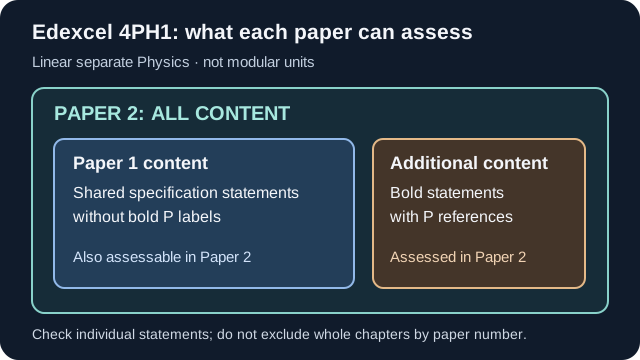
The specification distinguishes additional separate-Physics statements using bold text and a P reference. Paper 1 excludes these statements; Paper 2 includes them alongside the rest. Do not confuse that P label on a content statement with the P in an examination-paper code such as 4PH1/1P.
Create a checklist with two fields: 'shared content' and 'additional Paper 2 content'. For each statement, include evidence from a question you can solve, not just a tick for having read the page. Use a text-readable official specification so that formatting is preserved; a copied list that loses bold type can also lose the distinction you need.
Do not remove whole chapters from Paper 1 revision
The content boundary operates at specification-statement level, not simply at chapter level. A topic can contain shared material and additional statements. This means a generic list announcing that an entire chapter is 'Paper 2 only' may mislead you. Check the precise statements that your textbook section covers.
For example, electrical calculations using voltage, current and resistance are different from additional electrostatics requirements. They may sit next to each other in a broad electricity chapter, but you should map the individual content rather than colour the entire chapter one way. The same principle applies when selecting questions from a mixed topic worksheet.
Use the interval between papers intelligently
After Paper 1, use a coverage checklist to revisit additional Paper 2 statements and weak shared foundations. Do not use memories of Paper 1 to declare a topic impossible in Paper 2. Your preparation should follow the specification, not a belief that the papers divide every question into mutually exclusive topic lists.
An illustrative 60-minute session could use 15 minutes to recall and check an additional concept, 25 minutes on two relevant questions, 15 minutes correcting the reasoning and five minutes selecting a later reattempt. On another day, revisit a shared circuit or graph task. Adjust these times to the size of the gap rather than trying to complete every activity at the same speed.
Plan pacing from the actual paper you will sit
Paper 1 allows 120 minutes for 110 marks, and Paper 2 allows 75 minutes for 70 marks. Both average a little over one minute per mark before allowing checking time. Treat this as a broad planning observation, not a command to stop a four-mark question at exactly four minutes: reading and reasoning demands vary.
During practice, record why a task took too long. Was the delay identifying a model, converting units, interpreting an apparatus diagram or writing an overlong answer? Improving the specific bottleneck is more useful than repeatedly attempting to write faster. Learn when to leave a stalled question, record a useful first step and return later without losing track of the remaining work.
A final audit before choosing your next resource
Check that a resource says Edexcel International GCSE Physics 4PH1, that its content maps to your current specification, and that it preserves the shared/additional distinction. For a full timed assessment, verify the component and duration on the paper itself. An older question can still teach a principle, but do not assume an old booklet represents every current requirement.
If you need structured help, bring one shared-content mistake and one additional-content mistake to a teaching session. That makes it easier to decide whether the problem is coverage, understanding or exam technique. Use the relevant linear course page when enquiring; asking simply for 'Paper 2 tuition' leaves the qualification ambiguous.
Questions, explained
Choose a question for a direct answer, then explore the explanation and supporting resources. Each answer has its own link to save or share.
Is Edexcel IGCSE Physics Paper 2 only the extra topics?
No. For 4PH1, Paper 2 can assess all the specification content, including the additional bold P statements. Keep the shared foundations in your revision alongside the additional material. Do not discard a topic because it appeared in Paper 1 or because its basic content was taught earlier.
Do I choose either Edexcel Physics Paper 1 or Paper 2?
Not for the separate linear 4PH1 Physics qualification: both papers are required. They are untiered components, not Core and Extended alternatives. If you are taking a Science award rather than separate Physics, check that award's own assessment requirements with your school.
Is Edexcel IGCSE Physics Paper 2 harder than Paper 1?
Paper 2 includes additional content, but a student's experience also depends on topic strengths and question demands. Prepare its full scope rather than relying on a simple harder/easier label. Practise explanations and application as well as the additional calculations, and diagnose mistakes from actual work.
Is Edexcel linear Paper 1 the same as modular Unit 1?
No. The modular qualification divides the Physics content into separate units. A complete linear Paper 1 is not a modular Unit 1 mock, although selected questions may be relevant after checking their content. Use the full qualification and component codes to avoid mixing the two structures.