IGCSE · 12 July 2026 · 4 min read
Six-mark physics questions: how to structure an explanation
Updated 25 September 2026
Ask a student what they fear on an IGCSE physics paper and they rarely say the calculations. They say the long questions — the six-mark explains at the end of the paper, where confident students write half a page and receive two marks.
There is no universal rule that six marks means six separate sentences. Requirements depend on the question and its mark scheme. A reliable approach is to answer the command word, select the relevant physics and make the links in your reasoning explicit.
Why good students score badly
Students write what they know instead of what is asked. They repeat one idea in three different sentences — which earns one mark, once. They explain brilliantly but skip the 'obvious' step, and the obvious step was on the checklist. Length is not the goal; coverage is.
The formula
Before writing, plan the principles, evidence or steps the question needs. Put explanations in a logical order, using “because” and “therefore” when the relationship is causal. Name quantities clearly so that the reader knows what is increasing or decreasing. Use the mark allocation to judge depth, without forcing one sentence per mark.
After writing, check that each statement is relevant and scientifically correct. Remove contradictions and repeated ideas. If the question asks for a comparison, address both cases; if it asks for evaluation, use the evidence and explain the limitations.
Make the physics clear, connect the reasoning and answer the question asked.
Train it on past papers
Choose a small set of longer questions from your own board. Plan an answer, write it and compare it with the specific scheme. Note missing physics, unsupported conclusions and unclear links. Then attempt another question on the same topic in a different context to check that the reasoning transfers.
Questions, explained
Choose a question for a direct answer, then explore the explanation and supporting resources. Each answer has its own link to save or share.
How do I turn a Physics description into an explanation?
A description states what happens; an explanation connects it to a physical cause. Start with the observed change, identify the relevant principle, then show why that principle produces the change. Name the quantities rather than relying on 'it increases' or 'there is more energy'.
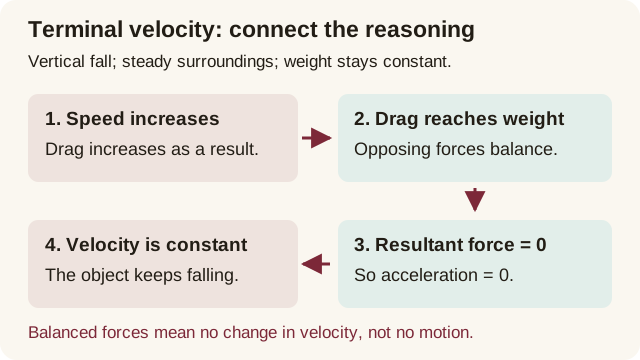
'The falling object reaches a constant speed' describes the motion. To explain it, state that drag increases as speed rises until drag equals weight; the resultant force is then zero, so acceleration is zero and velocity remains constant. Keep the assumptions clear: this describes a vertical fall under otherwise steady conditions. The explanation works because each link follows from the previous one, not because it contains a fixed number of sentences.
Can I use bullet points in a long Physics answer?
Bullet points can make distinct steps clear when the question allows them, but they still need complete scientific meaning and logical connections. A list of isolated keywords is not an explanation. Follow any explicit format instruction and the requirements of the particular question.
Compare 'current; heating; resistance' with 'the current heats the filament; its temperature rises; the higher temperature increases its resistance'. The second version identifies both the sequence and the quantities. For a comparison, pair the two cases under the same condition. For an evaluation, connect the evidence to a conclusion and its limitation. The command word determines the job your answer must do.
When does a diagram improve a written Physics answer?
Use a diagram when position, direction or a connection is difficult to express clearly in words. Label the relevant quantities and refer to the diagram in your explanation. A sketch supports reasoning; it does not automatically replace a written justification or the calculation requested.
In a forces question, draw arrows for the forces on the chosen object, then state the resultant in your selected direction. Do not add an 'acceleration force': acceleration is the consequence of the resultant. In a ray question, label the normal and measure angles from it. A small accurate diagram is more useful than a decorative drawing that leaves directions or labels ambiguous.
Sources and specifications
- Cambridge IGCSE Physics 0625 syllabus, 2026–2028
- Pearson Edexcel International GCSE Physics: specification and assessment materials
- Cambridge published marking principles, including scientific meaning and alternative wording
- Pearson Edexcel 4PH1 Paper 2P mark scheme, June 2023: marking guidance and accepted alternatives