Revision methods · 26 September 2026 · 6 min read
Open-book or closed-book Physics practice: which should you use?
An open-book answer can be a successful learning activity without being evidence of exam readiness. A closed-book failure can be useful information without meaning the topic is impossible. The question is which form of practice matches the stage you are at and what you want the attempt to show.
This guide explains how to move from an example to independent work. “Closed book” here means without your learning notes or solution; a realistic exam rehearsal must still include any reference material officially provided or permitted for your particular component.
Decide whether the session is for learning or checking
If you are encountering a relationship for the first time, access to an explanation and worked example can help you understand the decisions. If you are checking whether you can apply the topic independently, looking at the solution changes the meaning of the attempt. Name the purpose before starting: learn, reduce support, diagnose or rehearse.
This prevents an unhelpful argument about whether notes are always good or always bad. The same question can serve different purposes, but the evidence it produces changes with the conditions. A fully correct answer completed beside a worked solution shows that you followed the support; it does not necessarily show that you would choose the method without it.
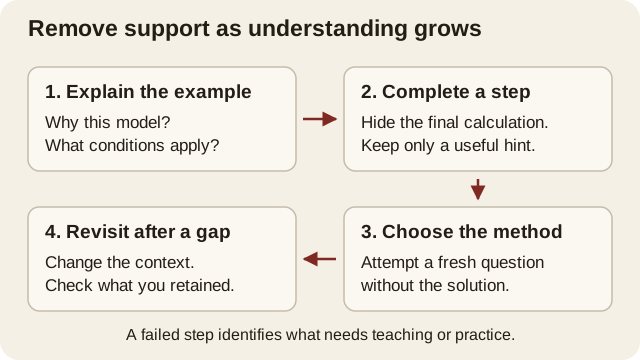
Begin with a worked example you explain actively
Read the example one step at a time and say why each step is used. For an original motion example, an object increases velocity uniformly from 2.0 m/s to 8.0 m/s in 3.0 s. Acceleration is change in velocity divided by time: (8.0 − 2.0)/3.0 = 2.0 m/s². The constant-acceleration condition also allows the usual constant-acceleration equations.
Ask what would make the method inappropriate. Average acceleration can still be calculated from endpoint velocities and elapsed time, but that does not prove acceleration was constant during the interval. This distinction turns a worked example into a model discussion. If the explanation is unclear, resolve it before hiding all the support and repeatedly failing the same step.
Remove support in small, observable stages
First hide the final calculation but keep the diagram or chosen equation. Next hide the equation and choose it yourself from the information. Finally attempt a changed question with no worked example visible. Keep the level of support clear. This staged method is an academy practice suggestion; it is not a required sequence for every topic or learner.
For the motion example, change the initial velocity, final velocity and time. Then ask for a different quantity, such as final velocity given acceleration. A student who can only repeat the original subtraction may struggle when the unknown changes. That difficulty identifies what to practise next: interpreting the quantities or rearranging the relationship, rather than simply memorising another numerical example.
Use a fresh question to check independent understanding
Choose a question with different numbers, wording or context and attempt it before looking at notes. Write down the first step where you need help. If a small hint is used, record it and continue productively, but label the attempt as supported. The aim is accurate information about your learning, not protecting a perfect-looking score.
Research on retrieval supports attempting to recall and reconstruct learned material. It does not imply that unsupported struggle is always the best way to learn an unfamiliar complex task. If you have no usable starting model, return to instruction. If you know the model but cannot retrieve a relationship, a targeted recall exercise may be appropriate. The kind of failure determines the next action.
Revisit the skill after a gap and mix contexts
An immediate successful variation is encouraging, but the method may still be held in short-lived familiarity with the example. Revisit it in a later session, then combine it with another topic where appropriate. A force question followed by a motion question may require selecting between F = ma and a = Δv/Δt rather than being told which formula family to use.
Keep the mixture purposeful and within your course. A student still learning basic unit conversion may need focused practice before a long mixed paper. As independence improves, reduce topic labels and familiar ordering so you practise recognising the underlying model. Use feedback after the attempt to find whether the difficulty came from recall, selection or execution.
Make exam rehearsal honest and use its results carefully
For a mock-style attempt, use the correct time allowance and only the resources permitted for that paper. Confirm current rules through the board and your centre. If a formula sheet is supplied in the real assessment, excluding it from every rehearsal may create a different task; if it is not supplied, unrestricted access to your own notes does not simulate the exam.
Record the conditions beside the score: fresh or previously seen, timed or untimed, independent or supported. Compare like with like when evaluating progress. After marking, return to open-book learning where necessary and then test again on a fresh task. Moving back to support is a sensible repair decision, not a failure to keep every future session closed book.
Questions, explained
Choose a question for a direct answer, then explore the explanation and supporting resources. Each answer has its own link to save or share.
Is open-book Physics practice cheating?
Not when it is a learning activity where notes are allowed. It becomes misleading if you report the score as independent exam performance, or violates a task’s rules. Label the support used and follow teacher instructions for assessed work and formal practice tests.
When should I stop using notes for Physics questions?
Start removing support once you can explain the example’s method and conditions. Try a changed question without the solution, record where you need a hint and repair that step. There is no need to wait until every topic feels perfect before attempting independent practice.
What if I cannot solve any Physics questions without my notes?
Identify whether you are missing the concept, the equation, a mathematical step or the ability to choose a model. Relearn the first failed step with a worked example, then remove support gradually. Repeatedly staring at an unfamiliar question without feedback is unlikely to diagnose the gap well.
Should I use a formula sheet during Physics revision?
Use it when learning relationships or when it matches the resources allowed for the intended practice task. For exam rehearsal, confirm what your actual paper provides. In either case, practise choosing the relationship, interpreting symbols and checking conditions rather than only locating a formula.
Does getting a repeated Physics question right show I understand it?
It is useful evidence, but familiarity with the answer may help. Try a question with changed data, a different unknown or a new context, then revisit the skill after a gap. Independent success across variations gives stronger evidence than reproducing one recently studied solution.
Sources and specifications
- Karpicke and Blunt: retrieval practice and meaningful learning of science texts
- Education Endowment Foundation: cognitive science approaches in the classroom evidence review
- Cambridge IGCSE Physics: current syllabus and assessment resources
- Pearson Edexcel International A Level Physics: specification and assessment resources