Practical skills · 25 September 2026 · 6 min read
Accuracy, precision and resolution in physics: identify the error before fixing it
An instrument can show many digits and still give the wrong result. Repeated measurements can agree closely while all being shifted in the same direction. These are not contradictions: accuracy, precision and resolution describe different features of measurement.
The useful exam skill is diagnosing what has happened and choosing an improvement that addresses it. This guide uses a simple length example before applying the distinctions to school practical work. The numerical examples are invented to make the reasoning visible, rather than copied from an examination paper.
Compare a set of readings with a reference value
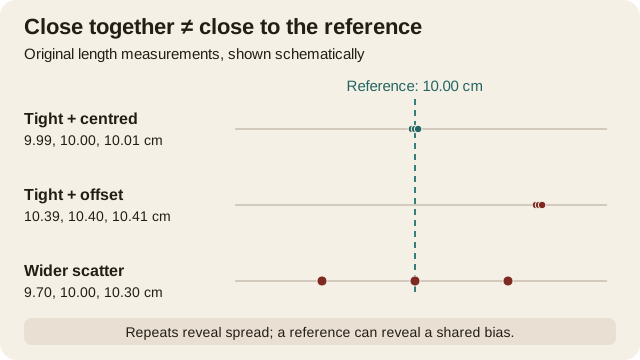
Imagine measuring a reference length known, for this teaching example, to be 10.00 cm. Readings of 10.01 cm, 10.00 cm and 9.99 cm lie close together and close to the reference. A second set, 10.41 cm, 10.40 cm and 10.39 cm, also lies close together, but is consistently high. The second set shows good repeatability without good agreement with the reference.
In real experiments the true value may not be known exactly. You may compare with an accepted value that has its own uncertainty, or evaluate agreement between independent methods. Avoid claiming that a small spread proves accuracy. A narrow spread tells you something about the repeated measurements, but cannot reveal every bias shared by them.
Separate instrument resolution from experimental precision
Resolution describes the smallest change distinguishable on a scale or display. A digital balance displaying 12.34 g in steps of 0.01 g has a display resolution of 0.01 g. That does not prove that the mass is correct to 0.01 g: calibration, vibration, air movement and the measurement method can affect the result.
Likewise, a stopwatch may display hundredths of a second while human start-stop timing varies much more than one display step. Upgrading the display alone may barely improve that experiment. Choose an instrument whose range and resolution suit the measurement, then consider the whole method. When a question asks for a reading uncertainty, follow its stated convention and your board’s guidance rather than treating resolution as a universal uncertainty value.
Identify random variation and what repeats can achieve
Random effects produce unpredictable variation between readings. Repeated stopwatch timings might be above or below the mean because the start and stop decisions vary. For comparable measurements with independent random variation, averaging can reduce its effect on the estimated result. Keep the individual readings so the spread remains visible.
Repeats must actually repeat the measurement. Reading the same stationary digital display three times without resetting or remeasuring may provide little information about the variability of the full procedure. Similarly, several people copying one reading are not independent repeats. Explain what is reset, remeasured or repositioned, and use the resulting variation to decide whether further readings or a different method would help.
Find systematic effects before calculating a more precise mean
A systematic effect changes results in a consistent way under the measurement conditions. A balance that reads +0.20 g when empty can add an offset to every mass measurement. If the offset is stable and the procedure permits correction, subtracting it addresses the problem; simply taking more readings does not. Checking or resetting the instrument before use is preferable to ignoring the bias.
Not every systematic effect is a fixed addition. A wrongly calibrated scale can multiply readings by an incorrect factor, and heat loss can bias an energy experiment in a way that depends on temperature and time. Describe the mechanism. The phrase ‘human error’ is too vague to tell an examiner or another investigator what went wrong or how to improve it.
Match each proposed improvement to the limitation
If repeated times have a large spread, measuring a longer interval or using suitable automated timing may help. If a ruler’s zero is damaged, measure between two undamaged scale positions and subtract, while considering the uncertainty in both readings. If the viewing angle creates parallax, place the eye appropriately or use a suitable alignment aid. Each change has a specific target.
An improvement can have trade-offs. A longer wire may give a larger measurable resistance, but its heating still needs controlling. More repeated measurements take time and may allow experimental conditions to drift. Strong evaluation does not praise every possible change; it identifies the dominant limitation and explains why the proposed method is realistic for the apparatus and range being used.
Write conclusions that match the evidence
Use cautious, concrete statements: ‘The repeated values have a smaller spread’ or ‘The mean is closer to the accepted value’. Neither statement automatically implies the other. Where uncertainty intervals are supplied, compare the measurements using those intervals and the method required by the question, rather than judging agreement from the last displayed digit alone.
For revision, take one practical result and answer three questions: What can the instrument distinguish? How much do repeated measurements vary? What could shift all the readings? Then propose a separate action for each important limitation. This short routine turns vocabulary into a method for evaluating unfamiliar experiments, which is more useful than memorising disconnected definitions.
Questions, explained
Choose a question for a direct answer, then explore the explanation and supporting resources. Each answer has its own link to save or share.
Can measurements be precise but not accurate?
Yes. A balance with a stable zero offset can give closely agreeing readings that are all too high. Their small spread shows precision under those conditions, while comparison with an appropriate reference reveals the bias. More repeats do not remove the offset. Check the zero or calibration and correct the method before relying on a more finely calculated mean.
Is instrument resolution the same as measurement uncertainty?
No. Resolution is the smallest change the instrument can distinguish. Total measurement uncertainty also depends on the method and other effects, such as reaction time, alignment or variation between repeats. An exam may prescribe a convention for estimating uncertainty from the scale or display; follow that convention without assuming the display resolution describes every source of uncertainty.
Why does averaging not remove systematic error?
A systematic effect remains shared by the readings being averaged. If each reading includes a stable +0.20 g offset, their mean includes that offset too. Averaging can reduce the effect of random variation, but the offset needs a zero check, calibration correction or change in method. Identify the cause before deciding what improvement is appropriate.