Mechanics · 26 September 2026 · 6 min read
M1 Mechanics moments: beams, reactions and tipping questions
A moments calculation becomes much simpler when the diagram is complete. Mark the beam’s length, supports, loads, centre of mass and unknown reactions before selecting a pivot. The most convenient pivot often removes one unknown reaction from the moment equation, but it does not remove that force from the physical system.
These original examples are for Edexcel International A-Level Mathematics M1, WME01. A beam is modelled as a rigid body, which differs from a particle model because the positions of forces matter. The academy’s M1 teaching is online and separate from its Physics examination courses.
Use perpendicular distance, not whichever length is labelled
The moment magnitude is force multiplied by the shortest distance from the pivot to the force’s line of action. For vertical loads on a horizontal beam, that distance is a horizontal separation. For an inclined beam carrying vertical forces, the required distances are horizontal projections, not simply lengths measured along the beam.
Choose clockwise or anticlockwise as positive and retain the choice. A force acting through the pivot has zero moment about it, even if it is large. That is why choosing a support as pivot can simplify an equation; it is not permission to omit the support reaction from the vertical force balance.
Worked example: reactions at two supports
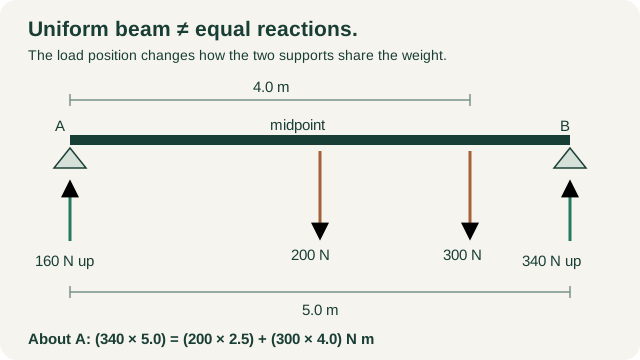
A uniform horizontal beam AB is 5.0 m long and weighs 200 N. It rests on supports at A and B, and a 300 N downward load acts 4.0 m from A. The beam’s own weight acts 2.5 m from A. Taking moments about A gives RB × 5.0 = 200 × 2.5 + 300 × 4.0, so RB = 340 N.
Vertical equilibrium gives RA + RB = 500 N, hence RA = 160 N. The larger reaction is near the extra load, which is physically sensible. Taking moments about B supplies an independent check: RA × 5.0 = 200 × 2.5 + 300 × 1.0 = 800 N m. Do not assume equal reactions just because the beam is uniform.
Change the load position and predict the reactions
Move the 300 N load to the midpoint while keeping the same supports. Symmetry now gives equal reactions of 250 N. Move it towards A, and A’s reaction increases while B’s decreases. The sum remains 500 N because the total downward load has not changed.
For a load at distance x from A, the general equation is RB = (500 + 300x)/5. Keeping this symbolic expression can be more informative than solving several disconnected numerical cases. It shows directly how moving the load changes the distribution between the supports and helps check a numerical answer.
Worked example: a vertical force on an inclined rod
A 2.0 m rod is inclined at 30° above the horizontal. A vertical downward force of 60 N acts at its upper end. About the lower end, the perpendicular distance to this vertical force is the horizontal projection 2.0 cos 30° = 1.73 m. Its moment magnitude is therefore 60 × 1.73 = 104 N m. Multiplying by 2.0 directly would use the wrong distance.
If the rod is turned until it is vertical, the same vertical force passes through the lower-end pivot and its moment is zero. The force still affects the vertical force balance. This comparison stays with parallel vertical forces, as in M1 moment models; do not import more advanced rigid-body arrangements simply because they use the same word “moments”.
Worked example: find the tipping threshold
A different uniform beam is 6.0 m long and weighs 200 N. Supports are at its left end A and a point B 4.0 m from A. A 300 N person stands at distance x from A on the overhang beyond B. At the tipping threshold about B, the reaction at A is zero. The beam’s weight acts 1.0 m to the left of B.
Balance moments about B: 200 × 1.0 = 300(x − 4.0). Therefore x = 4.67 m. At this threshold B supports the total 500 N. Beyond it, an equilibrium calculation would require a negative reaction at A, but an ordinary support underneath cannot pull down. The assumed two-support equilibrium has therefore ceased to be possible.
Check the model before adding more equations
“Uniform” places the centre of mass at the geometric midpoint for this straight beam model. “Non-uniform” means you need the centre-of-mass position or enough information to determine it. “Light” allows the component’s weight to be neglected. Read these words before deciding which forces to include.
Before finishing, check vertical and horizontal force balance where relevant, moment balance about one point, the physical sign of reactions and whether contact is maintained. Practise a support problem, an inclined-beam problem and a tipping problem as different decisions. Memorising one beam equation will not cover all three.
Questions, explained
Choose a question for a direct answer, then explore the explanation and supporting resources. Each answer has its own link to save or share.
Which pivot should I choose in a moments question?
Choose a point that makes the equations simple, often where an unknown reaction acts. A force through that pivot has zero moment about it. You still need the appropriate force-balance equations, and the physical answer should agree if you check moments about another point.
Why must I use perpendicular distance for a moment?
Only the component of force acting perpendicular to the position from the pivot produces the turning effect. Multiplying force by perpendicular distance accounts for that geometry. Alternatively, multiply the perpendicular force component by the distance along the rod; the two methods agree.
What does a uniform beam mean in M1?
Its mass is distributed uniformly along its length in the model, so its weight acts through the midpoint. It does not imply equal support reactions when the supports or other loads are asymmetric. Include the beam’s weight unless it is explicitly light or negligible.
What condition should I use when a beam is about to tip?
The reaction at the support that is just losing contact becomes zero. Take moments about the remaining contact point and check the force balance. Which support loses contact depends on the loading and geometry; identify it from the diagram rather than applying a memorised left-or-right rule.
What does a negative support reaction mean?
For an ordinary support underneath a beam, a negative calculated reaction means the assumed contact equilibrium is not physically possible: that support would have to pull downward. Reconsider loss of contact or tipping. A tie, hinge or other constraint may permit different force directions and needs its own model.