IGCSE · 26 September 2026 · 6 min read
Momentum and collision questions: signs, systems and stopping forces
Most momentum mistakes happen before the arithmetic. Students add speeds without directions, conserve momentum for only one object or use the mass of one trolley after two trolleys stick together. Drawing a simple before-and-after diagram makes these choices visible.
The examples below are original practice for relevant IGCSE momentum objectives, including Cambridge Supplement and Edexcel separate-Physics content. Check your route's requirements. Each calculation states the system and assumptions so that the equation has a physical reason to apply.
Choose the system and a positive direction
Momentum is mass multiplied by velocity, p = mv. Because velocity has direction, momentum has direction too. For motion along one line, choose a positive direction and represent motion the other way with a negative velocity. State that choice once and keep it throughout the calculation.
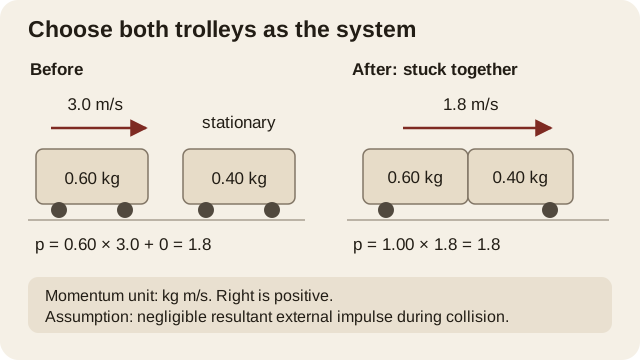
For a collision between two trolleys, choose both trolleys as the system. Their mutual collision forces are internal. Total momentum is conserved when the resultant external impulse over the short interaction is negligible. This does not mean each trolley keeps its original momentum; their individual momenta change through the interaction.
Worked example: two trolleys stick together
A 0.60 kg trolley moves right at 3.0 m/s and strikes a stationary 0.40 kg trolley. They stick together; take right as positive and neglect external impulse. Initial total momentum is 0.60 × 3.0 + 0.40 × 0 = 1.8 kg m/s. Combined mass is 1.00 kg, so final common velocity is 1.8 / 1.00 = 1.8 m/s right.
Check that the final speed is lower than the moving trolley's initial speed because the same total momentum is now carried by more mass. The initially stationary trolley contributes zero initial momentum, but its mass still matters after the collision. Omitting it from the final mass would incorrectly leave the first trolley's speed unchanged.
Change the second trolley's direction
Keep the first trolley unchanged, but now let the 0.40 kg trolley move left at 1.0 m/s before they stick. Its velocity is −1.0 m/s, so total initial momentum is 0.60 × 3.0 + 0.40 × (−1.0) = 1.4 kg m/s. The combined final velocity is therefore +1.4 m/s, meaning right.
A result of 2.2 m/s would come from adding momentum magnitudes while ignoring the opposing direction. If the signed total had been negative, the joined trolleys would move left. If it were zero, their common final velocity in this sticking model would be zero. The sign carries physical information rather than indicating an arithmetic failure.
Worked example: rebound and average force
A 0.20 kg ball approaches a wall at 8.0 m/s and rebounds at 6.0 m/s. Choose motion towards the wall as positive, so u = +8.0 m/s and v = −6.0 m/s. The ball's change in momentum is m(v − u) = 0.20 × (−6.0 − 8.0) = −2.8 kg m/s.
If contact lasts 0.040 s, the average force on the ball is Δp/Δt = −2.8 / 0.040 = −70 N, or 70 N away from the wall. Subtracting speed magnitudes, 8 − 6, would miss the reversal. The ball alone does not conserve momentum during contact because the wall exerts an external force on that chosen system.
Explain safety using time and momentum change
Suppose a passenger undergoes approximately the same velocity change with and without a cushioning device. Increasing the time over which that change occurs reduces the average force for the same momentum change. This is the useful link between a longer stopping interval and a reduced average force; saying the passenger has less momentum is not generally the explanation.
State the comparison carefully. The force during a real collision varies, so the equation gives an average over the stated interval. Peak force and the details of the collision need more information. Likewise, stopping distance and stopping time are related through the motion but are not interchangeable symbols in Δp/Δt.
Check energy separately and practise independently
For the first sticking example, initial kinetic energy is ½ × 0.60 × 3.0² = 2.7 J. Final kinetic energy is ½ × 1.00 × 1.8² = 1.62 J. Momentum is conserved, but 1.08 J is transferred from the kinetic energy of the trolley motion into other forms, including deformation and internal energy. Total energy conservation has not failed.
Try a fresh question: a 0.50 kg trolley at 4.0 m/s joins a stationary 1.50 kg trolley. Initial momentum is 2.0 kg m/s and total mass is 2.0 kg, so final velocity is 1.0 m/s in the original direction. Explain the assumptions, then repeat with the second trolley moving oppositely. A correct signed setup is the habit to retain.
Questions, explained
Choose a question for a direct answer, then explore the explanation and supporting resources. Each answer has its own link to save or share.
Can momentum be negative?
In a one-dimensional calculation, a negative sign means momentum points opposite to your chosen positive direction. It does not mean the mass is negative. Choose the positive direction first and use signed velocities consistently for every object.
Which mass do I use when two objects stick together?
Use the combined mass for their common final velocity. Calculate each object's signed initial momentum, add them, and divide the total by the combined mass when external impulse is negligible. A stationary object's initial momentum is zero, but its final contribution is not ignored.
Is kinetic energy always conserved when momentum is conserved?
No. Total momentum can be conserved in an isolated collision while kinetic energy decreases, as when objects stick and deform. Energy is transferred into other forms. Kinetic energy is conserved only for an elastic collision, not for every momentum-conservation question.
Why do I add speed magnitudes for a rebound momentum change?
The velocities have opposite signs. Using Δp = m(v − u) automatically accounts for that reversal, so the magnitude of the velocity change can equal the sum of the two speed magnitudes. Work with signed velocities rather than memorising an add-or-subtract shortcut.
Why does a longer stopping time reduce average force?
For the same change in momentum, average force equals that change divided by the interaction time. Increasing the time reduces the average force. State that the momentum change is being held constant, and distinguish the average force from the peak force during a real collision.