A-Level · 26 September 2026 · 6 min read
Young modulus, stress and strain: worked A-Level Physics questions
A wire calculation can be algebraically correct and physically wrong if its area, extension or graph axis has been misread. These questions reward careful definitions before arithmetic. The same material can have a different stiffness when its dimensions change, while its Young modulus remains a material property under the stated conditions.
The original problems below develop materials reasoning used in Edexcel International AS Physics Unit 1. They are also useful practice for other A-Level courses where these ideas are specified. Check your board’s scope and practical requirements rather than assuming every materials graph uses the same conventions.
Write the geometry and the measured change separately
Use L for original length and ΔL for extension. The final length is L + ΔL; it is not the quantity in the numerator of strain. Cross-sectional area is the area normal to the tensile force, not the exposed surface area of the wire. For a circular wire, A = πd²/4 when d is its diameter.
Convert before combining: 0.50 mm is 5.0 × 10⁻⁴ m, so its area is about 1.96 × 10⁻⁷ m². Converting an area from mm² to m² requires a factor of 10⁻⁶, not 10⁻³. A short unit line can prevent an error several orders of magnitude larger than any measurement uncertainty.
Worked example: find Young modulus from a wire extension
A wire of original length 2.0 m and cross-sectional area 2.0 × 10⁻⁷ m² extends by 2.0 mm under a tensile force of 40 N. Assume the measurements are within the linear elastic region. Stress = 40/(2.0 × 10⁻⁷) = 2.0 × 10⁸ Pa. Strain = 0.0020/2.0 = 1.0 × 10⁻³. Therefore E = 2.0 × 10¹¹ Pa.
Check the answer through E = FL/(AΔL), then explain it: a small fractional extension requires a substantial stress. Do not attach units to strain because it is a ratio of lengths. Young modulus does have units, the same as stress. A numerical answer without these distinctions leaves common misconceptions hidden.
Change the wire dimensions without changing the material
For the same material in the same linear regime, ΔL = FL/(AE). Double the length while holding force and area fixed, and the extension doubles. Double the diameter, and the area becomes four times larger, so the extension becomes one quarter. Neither change implies that the material’s Young modulus has changed.
Apply this to the worked wire: increasing its length from 2.0 m to 4.0 m gives 4.0 mm extension at 40 N. Increasing its area to 8.0 × 10⁻⁷ m² instead gives 0.50 mm extension. State which quantities you hold fixed. “A thicker wire stretches less” is incomplete if the load has also been changed.
Worked example: interpret the gradient and area of a graph
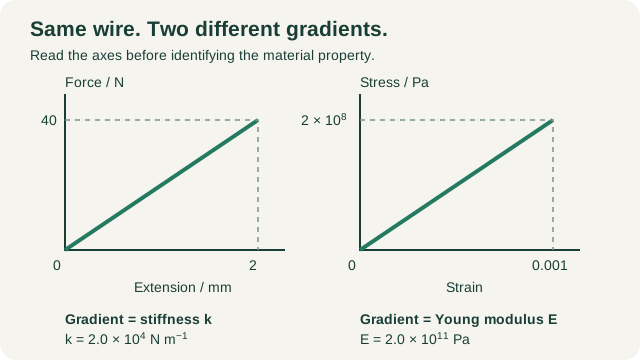
The wire’s force–extension graph is straight from the origin to 40 N at 0.0020 m. Its gradient is 2.0 × 10⁴ N m⁻¹, the stiffness k for that sample. Young modulus is kL/A, which gives 2.0 × 10¹¹ Pa. If the graph instead plots stress vertically against strain horizontally, its linear gradient directly gives E.
The area beneath this force–extension graph is ½ × 40 × 0.0020 = 0.040 J of stored elastic energy. The area beneath a stress–strain graph has different units: Pa, equivalent to J m⁻³, so it represents energy per original volume in this small-strain treatment. Read the axes before deciding what an area means.
Distinguish linear behaviour, elasticity and strength
A straight-line force–extension relationship indicates proportionality in the measured region. Elastic behaviour means the object returns to its original dimensions when the load is removed. A material may behave elastically over a region that is not perfectly linear. Do not treat the limit of proportionality and elastic limit as interchangeable labels without the graph or definition supporting it.
Young modulus describes stiffness of the material’s initial stress–strain response, not automatically its breaking stress or toughness. Two materials can have similar initial gradients but fail at different stresses or strains. When comparing curves, name the property being compared and identify the feature on the graph that supports the statement.
Use the experiment to explain the uncertainty
Because area depends on diameter squared, a small fractional diameter uncertainty contributes roughly twice that fractional uncertainty to the calculated area. For example, 2% uncertainty in diameter gives approximately 4% in area for small uncertainties. Repeating diameter measurements at different positions also helps reveal whether the wire is uniform; it does not simply make a varying diameter disappear.
Before the next paper, practise one calculation, one graph interpretation and one comparison of two materials. Check original length, extension, area conversion, linear-region condition and the requested property. For practical questions, explain how the measurement method controls the uncertainty that matters rather than writing only “repeat for accuracy”.
Questions, explained
Choose a question for a direct answer, then explore the explanation and supporting resources. Each answer has its own link to save or share.
Is Young modulus the gradient of a force–extension graph?
Not directly. A force–extension gradient gives the stiffness of that sample. Multiply it by original length and divide by cross-sectional area to obtain Young modulus in the linear region. A stress–strain graph’s linear gradient directly gives Young modulus.
Why does strain have no unit?
Strain is extension divided by original length, so the length units cancel. Both lengths must use compatible units. A strain of 0.001 means an extension equal to one thousandth of the original length; it does not mean an extension of 0.001 m for every sample.
What happens to extension if wire diameter doubles?
For the same material, force and original length in the linear elastic regime, doubling diameter quadruples area. Since extension is inversely proportional to area, it becomes one quarter. The material’s Young modulus stays the same under these assumptions.
Does a high Young modulus mean a material is strong?
It means a large stress is needed for a given small elastic strain. Strength, breaking stress, ductility and toughness describe different properties. Compare the relevant graph features rather than using Young modulus alone to infer all of them.
How do I find elastic energy from a graph?
For elastic, reversible deformation, the area beneath force against extension gives stored elastic energy. A straight line through the origin gives ½FΔL; a curved graph needs its actual area. During plastic deformation, loading area gives work done, not all recoverable energy. Stress–strain area has energy-per-volume units in the usual small-strain treatment.