A-Level · 26 September 2026 · 6 min read
Circular motion questions: forces, speed and vertical-circle checks
A circular path does not introduce a new mysterious interaction. Tension, gravity, friction or another real force supplies the inward resultant required to change velocity. Most mistakes begin when a student draws those forces and then adds a separate “centripetal force” as well.
These original questions develop A2 reasoning for Edexcel IAL Unit 4. The method also transfers to other courses studying circular motion. Each example specifies the model; use the actual forces and geometry in your own question rather than importing a familiar diagram unchanged.
Draw real forces before writing mv²/r
Choose the object and mark the centre of its circular path. Draw only interactions acting on that object. Then choose inward as the positive radial direction and resolve the forces along it. The equation is resultant inward force = mv²/r. A vertical balance equation may also be needed if the circle is horizontal.
Uniform circular motion means constant speed, not constant velocity. The direction changes continuously, so acceleration is nonzero and points towards the centre. The inward force is perpendicular to instantaneous velocity in the ideal uniform case, so it changes direction without doing work that increases speed. Tangential forces would add another part to the motion.
Worked example: horizontal circular motion
A 0.40 kg object travels at 4.0 m s⁻¹ in a horizontal circle of radius 0.80 m. Its required inward resultant is 0.40 × 4.0²/0.80 = 8.0 N. If a horizontal tension is the only radial force, its magnitude is 8.0 N. If several forces have radial components, their signed sum must equal 8.0 N instead.
The period is circumference divided by speed: T = 2πr/v = 1.26 s. Angular speed is v/r = 5.0 rad s⁻¹. These quantities describe the same motion in different ways. Substituting period directly where speed belongs gives incompatible units and should fail a quick dimensional check.
Change the radius: what is held constant?
If speed stays at 4.0 m s⁻¹ and radius doubles, mv²/r halves. If angular speed stays fixed, v = ωr and the force becomes mω²r, so doubling radius doubles the required force. These statements are not contradictory; they describe different changes to the motion.
For a rotating platform turning once every fixed time interval, angular speed is fixed. For an object whose linear speed is controlled independently, speed may be fixed instead. Read the wording before using “inversely proportional to radius”. A proportionality statement is incomplete without its fixed quantities.
Worked example: forces at the top of a vertical circle
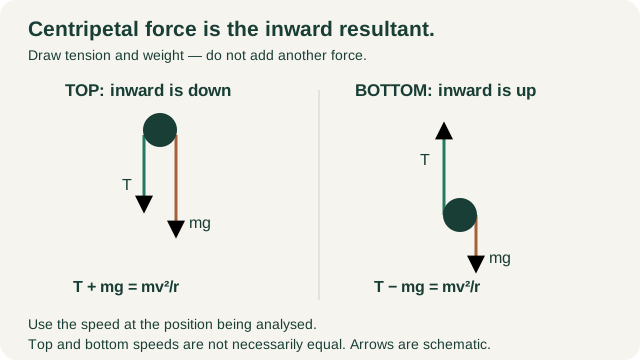
A 2.0 kg object on a light string moves at 10 m s⁻¹ at the top of a vertical circle of radius 5.0 m. Take g = 9.8 m s⁻². Inward is downward there. Tension and weight both point inward, so T + mg = mv²/r. The required resultant is 40 N and weight is 19.6 N, giving tension T = 20.4 N.
At the bottom, inward is upward, so T − mg = mv²/r. If the speed at that instant were also 10 m s⁻¹, tension would be 59.6 N. Those are separate instantaneous conditions: a freely moving system generally has different speeds at top and bottom, and energy reasoning may be needed to find them before calculating tension.
Worked example: the string must remain taut
At the top of a vertical circle, the smallest speed compatible with a just-taut string occurs at T = 0. Then mg = mv²/r and v = √(gr). For radius 5.0 m, the threshold is 7.0 m s⁻¹. Below that value, the equation would demand negative tension, which a string cannot provide.
This condition applies to the stated string model at the top. It is not automatically the condition for a rigid rod, track or any other constraint, which may provide forces in different directions. If your calculation produces an impossible reaction or tension, revisit whether contact or the assumed circular path can continue.
Check the model with direction, units and energy
Write one sentence naming the force provider and one naming the fixed condition. Then check units: mv²/r has units kg m s⁻², or newtons. Where speed changes with height, use the appropriate energy relationship before the radial force equation. Force and energy methods answer different parts of the same physical story.
For your next practice task, solve one horizontal circle and one vertical-circle point, then change either speed or radius and predict the effect. If you cannot predict the direction of change, return to the equation and its assumptions before doing another page of substitution. The goal is recognising the model in an unfamiliar context.
Questions, explained
Choose a question for a direct answer, then explore the explanation and supporting resources. Each answer has its own link to save or share.
Is centripetal force an extra force?
No. It names the inward resultant required for circular motion. Tension, gravity, friction or other real interactions can supply it. Draw those forces, resolve towards the centre and set the resultant equal to mv²/r. Adding another centripetal-force arrow would count the same effect twice.
Why is there acceleration at constant speed in a circle?
Velocity includes direction as well as speed. In circular motion the direction changes, so velocity changes and the object accelerates. For uniform circular motion, that acceleration is towards the centre and has magnitude v²/r.
Does a larger radius reduce centripetal force?
At fixed mass and linear speed, yes: mv²/r decreases as radius increases. At fixed angular speed, the force is mω²r and increases with radius. Identify what the question holds constant before making a proportionality claim.
Why is tension different at the top and bottom of a vertical circle?
Weight points downward at both positions, but inward is downward at the top and upward at the bottom. Therefore the radial equations are T + mg = mv²/r at the top and T − mg = mv²/r at the bottom. The speeds may differ as well.
What does negative tension mean in a circular-motion calculation?
A string cannot push, so negative tension indicates that the assumed taut-string circular motion is not physically possible under those conditions. Reconsider whether the string becomes slack or the path changes. A different constraint, such as a rigid rod, needs its own force model.