The key idea
Particle questions combine classification with bookkeeping. Identify the particle family, add conserved quantities and interpret the evidence before deciding whether an interaction is possible.
Understand it · 01
Classify before calculating
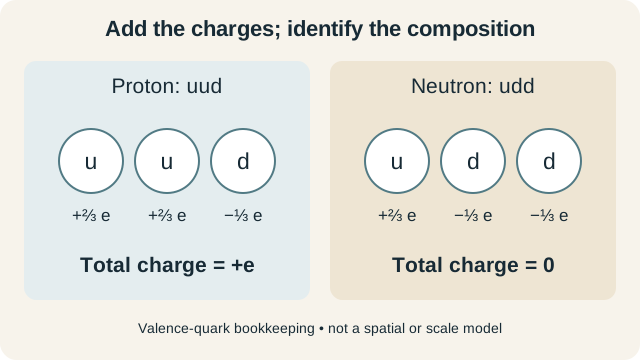
A proton and a neutron are both baryons, but neither is fundamental in the quark model. Their valence compositions are uud and udd respectively. Adding the signed quark charges gives +e and zero. A neutron’s zero net charge therefore does not mean that every constituent has zero charge. Mesons have a quark and an antiquark; for example, an up quark combined with an anti-down quark gives charge +e because reversing the down quark’s charge gives +e/3.
Electrons and neutrinos belong to the lepton family. They are not made from quarks in the Standard Model. Photons are a different kind of particle: they carry electromagnetic interactions and are neither baryons nor leptons. Use a small classification map to separate these categories before learning individual symbols. The map is a description of composition and properties, not a picture of tiny hard balls inside an atom. In particular, a neutron is not built from a proton with an electron attached.
The six quark flavours form three generations: up and down, charm and strange, top and bottom. The pattern of the model predicted a top quark before its observation. This illustrates how a scientific model can predict missing members rather than merely catalogue known particles. For charge bookkeeping, up, charm and top each have +2e/3, while down, strange and bottom each have −e/3; corresponding antiquarks reverse those charges.
Understand it · 02
Check a particle equation one quantity at a time
Make separate totals on the two sides of an interaction for charge, baryon number and lepton number. Assign baryons +1 and antibaryons −1; mesons and leptons have baryon number zero. At this level, leptons have lepton number +1 and antileptons −1, while hadrons and photons have zero. An antiparticle has the same rest mass as its partner; changing signs in conserved quantities does not mean changing the sign of mass or energy.
For neutron beta-minus decay, n → p + e⁻ + electron antineutrino, the final charge is +1 − 1 + 0 = 0 in units of e. Baryon number remains one. The electron contributes lepton number +1 and the antineutrino −1, leaving the initial total of zero unchanged. Energy and momentum must also balance. Passing these bookkeeping checks means a proposed process survives those tests; it does not establish that the process is energetically possible or has a significant probability.
Understand it · 03
Connect energy, fields and detector evidence
In annihilation, particle and antiparticle rest energy can become other forms of energy. An electron and positron with negligible initial kinetic energy have combined rest energy about 1.022 MeV. In a two-photon final state with the pair initially at rest, opposite photon momenta balance and each photon carries about 0.511 MeV. One photon alone could not conserve both energy and momentum for that isolated initially stationary system. If initial kinetic energy matters, include it in the total energy balance.
An electric field can do work on a charged particle, changing its kinetic energy. A magnetic field bends its path without doing work: for perpendicular motion in a uniform field, p = B|Q|r. Compare tracks at the same field and charge magnitude before concluding that a larger radius means greater momentum. Charged particles can leave ionisation tracks; neutral particles do not produce the same direct track but may be inferred from decay products and missing momentum. Lack of a visible line is not evidence that nothing travelled there.
Understand it · 04
Explain why accelerators need high energies
Small-scale structure is investigated using particles with short de Broglie wavelengths. Increasing momentum reduces λ = h/p and can therefore probe shorter length scales. High collision energy can also supply the rest energy needed to create heavier particles. These are related reasons for high-energy machines, but they answer different questions: one concerns resolving structure and the other concerns which final states are energetically accessible. Neither means that an accelerating particle’s electric charge becomes larger.
In a linear accelerator, electric fields across gaps increase particle energy; the field timing must accelerate rather than slow successive particles. A cyclotron uses magnetic bending and repeated acceleration across a gap. A heated source can release electrons by thermionic emission before an electric field accelerates them. At very high speeds, relativistic effects matter. For example, unstable fast particles can travel farther in the laboratory than a rest-frame lifetime estimate would suggest, so avoid blindly combining a rest lifetime with a laboratory flight distance.
Key definitions
- Baryon
- A hadron with three valence quarks, such as a proton or neutron. An antibaryon has three valence antiquarks.
- Meson
- A hadron consisting of a valence quark and antiquark, such as a pion.
- Lepton
- A fundamental matter particle, such as an electron or neutrino, which is not made of quarks and does not experience the strong interaction.
- Antiparticle
- The partner of a particle, with the same rest mass but opposite electric charge and additive quantum numbers where applicable. Some neutral particles are their own antiparticles.
- Electronvolt
- The energy transferred when a charge of magnitude e moves through a potential difference of 1 V: approximately 1.60 × 10⁻¹⁹ J.
Equations, units & conditions
Mass–energy change
ΔE = Δmc²
Units: J
Include both members of a particle–antiparticle pair when calculating their combined rest energy.
Energy gained through a potential difference
ΔEk = |Q|V
Units: J
For a particle moving through an accelerating potential difference of magnitude V, without other energy losses.
Momentum from track curvature
p = B|Q|r
Units: kg m s⁻¹
For motion perpendicular to a uniform magnetic field; use the charge magnitude.
Electronvolt conversion
1 MeV = 10⁶ eV ≈ 1.60 × 10⁻¹³ J
Worked examples, step by step
Determine charge from quarks
An up quark has charge +2e/3 and a down quark −e/3. Find the charges of uud and udd combinations.
Follow the method
- uud: +2e/3 + 2e/3 − e/3 = +e.
- udd: +2e/3 − e/3 − e/3 = 0.
uud is the proton’s valence composition and has charge +e; udd is the neutron’s and has zero net charge.
Practice questions with worked solutions
Try each question on paper before opening the solution. These are original academy questions; the suggested marks are a self-checking guide, not an official exam-board mark scheme. Difficulty labels describe this practice set, not predicted grades.
Starter · 3 suggested marks
1. Convert pair rest energy
An electron and positron are initially at rest. Each has rest energy 0.511 MeV. Find the total energy in joules using 1 eV = 1.60 × 10⁻¹⁹ J.
Show solution and self-check: question 1
- Combined rest energy = 2 × 0.511 = 1.022 MeV.
- 1.022 MeV = 1.022 × 10⁶ eV.
- Energy = 1.022 × 10⁶ × 1.60 × 10⁻¹⁹ = 1.6352 × 10⁻¹³ J.
Approximately 1.64 × 10⁻¹³ J.
Self-check · one mark per point
- Includes both particles’ rest energy.
- Converts MeV into eV.
- Converts to joules correctly.
Build · 3 suggested marks
2. Read momentum from a curved track
A singly charged particle moves perpendicular to a 0.60 T uniform magnetic field along a circular arc of radius 0.12 m. Find momentum using |Q| = 1.60 × 10⁻¹⁹ C.
Show solution and self-check: question 2
- For perpendicular motion, p = B|Q|r.
- p = 0.60 × 1.60 × 10⁻¹⁹ × 0.12 = 1.152 × 10⁻²⁰ kg m s⁻¹.
Momentum ≈ 1.2 × 10⁻²⁰ kg m s⁻¹ to two significant figures.
Self-check · one mark per point
- Uses the perpendicular-track relation.
- Substitutes the charge magnitude and radius.
- Gives momentum with SI units.
Common mistakes & how to avoid them
- Calling an electron a quark or treating a neutron as a proton plus an electron.
- Giving an antiparticle negative mass; rest mass stays positive and equal to its partner’s.
- Checking only electric charge while missing baryon or lepton number.
- Assuming conservation checks guarantee a process occurs; they are necessary conditions, not a probability calculation.
- Using p = mv at relativistic energies when momentum is the quantity supplied or inferred from curvature.
- Assuming a magnetic field increases a particle’s speed; magnetic force is perpendicular to its velocity.
Understand the why
Questions, explained
Start with the short answer, then follow the reasoning. Each explanation has a permanent link you can share with a classmate or return to when revising.
What is the difference between baryons, mesons and leptons?
Baryons contain three valence quarks and mesons a valence quark–antiquark pair. Leptons, such as electrons and neutrinos, are fundamental particles rather than quark composites.
Baryons and mesons are both hadrons and participate in the strong interaction. The proton and neutron are familiar baryons; pions are examples of mesons. A particle being neutral does not determine its family: a neutron is a baryon and a neutrino is a lepton. Classify using composition and interactions, then add charge as another property. Photons belong to neither the hadron nor the lepton category, so do not force every named particle into only those two groups.
How do quark charges explain the proton and neutron?
A proton has valence composition uud, whose charges add to +e. A neutron has udd, whose +2e/3, −e/3 and −e/3 charges sum to zero.
Write each charge with its sign before adding fractions. An antiquark has the opposite charge to the corresponding quark, so an anti-up has −2e/3 and an anti-down +e/3. The total can be an integer multiple of e even though the constituent quarks have fractional charges. Knowing only the net charge does not identify a unique composition: different particles can share the same charge. Use any additional information about particle family and other conserved quantities.
Follow the method
What is the charge of an up quark paired with an anti-down quark?
- Up contributes +2e/3; anti-down contributes +e/3.
- Add: +2e/3 + e/3 = +e.
Charge +e; this quark–antiquark combination has meson composition.
Does an antiparticle have negative mass?
No. A particle and its antiparticle have equal rest masses. Antimatter does not have negative mass. Their electric charges and relevant additive quantum numbers have opposite signs where applicable.
The positron has the electron’s rest mass but charge +e rather than −e. It is not a proton: the proton is a much more massive composite particle. Electric neutrality does not necessarily make a particle its own antiparticle, because other quantum numbers may distinguish the pair. A neutron and antineutron are neutral but have opposite baryon numbers. Keep mass, charge and particle-family bookkeeping in separate columns instead of changing every property’s sign mechanically.
How do I check whether a particle interaction is possible?
Check charge, baryon number and lepton number separately on each side, then energy and momentum. A violated conservation law rules out the proposed interaction.
Do not stop after the electric charges balance. In neutron beta-minus decay, the proton and electron have opposite charges, but the electron also introduces lepton number +1. An electron antineutrino supplies −1 so the lepton total stays zero. Conservation tests are necessary conditions: even an equation that passes them may require energy that is unavailable or an interaction mechanism you have not established. Explain which test fails when rejecting a proposed equation.
Follow the method
Test n → p + e⁻ for charge, baryon number and lepton number, ignoring any unlisted particles.
- Charge: 0 = +1 − 1, so charge balances.
- Baryon number: 1 = 1 + 0, so it balances.
- Lepton number: initial 0, final +1, so it does not balance.
The equation is incomplete; adding an electron antineutrino restores lepton-number balance.
Why does electron–positron annihilation at rest produce two opposite photons?
In the two-photon annihilation case, equal opposite photon momenta conserve the initially zero total momentum, while their energies carry away the pair’s rest energy.
A single photon always carries momentum as well as energy, so one photon alone cannot be the final state of an isolated electron–positron pair initially at rest. Two photons can have zero total momentum when their momenta are equal and opposite. For negligible initial kinetic energy each then carries about 0.511 MeV. This explains the familiar two-photon case; it is not a claim that every annihilation event under every condition has exactly that final state.
What does the radius of a particle track tell me?
For perpendicular motion in a known uniform magnetic field, p = B|Q|r. At the same field and charge magnitude, a larger radius means greater momentum.
A radius by itself is insufficient to identify the particle because the relation also includes charge magnitude and field strength. The direction of bending can indicate charge sign only after you know the particle’s direction of travel and the magnetic-field direction. Magnetic force changes direction of motion without supplying kinetic energy. If a track spirals inward through material, the decreasing momentum reflects energy loss to that material, not work done by the magnetic field.
How do I convert MeV/c² or GeV/c² into kilograms?
First convert the energy unit into joules, then divide by c². MeV/c² and GeV/c² are mass units, whereas MeV and GeV alone are energy units.
The notation comes from rearranging rest energy E = mc² to m = E/c². One megaelectronvolt is one million electronvolts; one gigaelectronvolt is one billion. Multiplying the energy in electronvolts by the elementary charge expressed numerically in coulombs converts it into joules. Then divide by the square of the speed of light in SI units. Keep the division by c² visible so you do not report an energy value as if it were a mass.
Follow the method
Convert 1.00 MeV/c² into kilograms using 1 eV = 1.60 × 10⁻¹⁹ J and c = 3.00 × 10⁸ m s⁻¹.
- 1.00 MeV = 1.00 × 10⁶ × 1.60 × 10⁻¹⁹ = 1.60 × 10⁻¹³ J.
- m = 1.60 × 10⁻¹³/(3.00 × 10⁸)² = 1.78 × 10⁻³⁰ kg.
1.00 MeV/c² ≈ 1.78 × 10⁻³⁰ kg; 1.00 GeV/c² is 1000 times larger.
Your learning checklist
Use these goals to check your understanding. Requirements vary by specification, tier and exam year; the official references below define your full course.
- Distinguish baryons, mesons, leptons and photons
- Work out charges from quark composition
- Deduce corresponding antiparticle properties
- Check charge, baryon number, lepton number, energy and momentum
- Use mass–energy and electronvolt conversions
- Connect acceleration and detector tracks to electric and magnetic fields
Sources & how to cite these notes
Original explanations, illustrations and practice by Dr Desouky Physics Academy. Official specifications guide the course scope; questions and suggested marks on this page are our own revision material.
- Pearson Edexcel International AS/A Level Physics — specification
- CERN: the Standard Model and particle families
Reference this page
Dr Desouky Physics Academy. Edexcel IAL Physics: Particle physics and the quark model. Updated 2026-09-26. https://www.drdesouky.com/revision/a-level-physics/particle-physics
Use the arrow beside an explanation heading to link straight to that section. Spotted a problem? Contact the academy with the topic and the step you want us to check.