The key idea
A falling ball in a liquid links density, Newton’s laws and a measurable material property: viscosity. Draw all three forces before using an equation, then check whether the flow model is appropriate.
Understand it · 01
Separate weight, upthrust and drag
Choose the ball as your system. Its weight acts downward and is its own mass multiplied by g. The liquid also pushes on every part of its surface. Because pressure is greater lower down, the fluid forces have an upward resultant: upthrust. For a fully immersed object, the displaced volume equals the object’s volume, but the displaced mass uses the liquid’s density. A dense ball and a hollow ball of identical external volume receive the same upthrust in the same liquid.
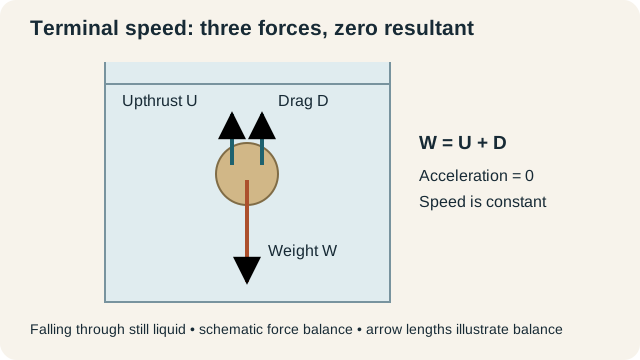
Viscous drag is a different interaction. It opposes the ball’s motion relative to the surrounding liquid. If a ball is released from rest in still liquid, its drag starts at zero in the simple steady-flow model and grows as it speeds up. Its weight and, while fully immersed, its upthrust remain approximately constant. The increasing upward drag reduces the downward resultant, so acceleration falls. Terminal speed is reached when that resultant becomes zero, not when the downward motion stops.
Understand it · 02
Use Stokes’ law within its assumptions
For a sphere in sufficiently slow flow, D = 6πηrv. The equation predicts that doubling relative speed doubles drag while radius and viscosity stay fixed. This linear model is appropriate when viscous effects dominate over fluid inertia. It is not the quadratic drag model often used for a fast object moving through air. Writing an equation without identifying the shape, flow conditions and relative speed can therefore give an apparently precise answer from an unsuitable model.
For a sinking sphere at terminal speed, substitute weight ρsphere(4πr³/3)g and upthrust ρfluid(4πr³/3)g into weight = upthrust + drag. Cancelling common factors gives vt = 2r²(ρsphere − ρfluid)g/(9η). This predicts a radius-squared relationship, but only while the same flow model remains valid. A very large ball may fall fast enough to invalidate the approximation. If the two densities are equal, there is no net gravitational driving force and the predicted settling speed is zero.
Understand it · 03
Measure viscosity using a falling ball
Use a tall, wide transparent container, small spheres of known density and a liquid whose density is measured or supplied at the working temperature. Measure each diameter carefully and halve it before substitution. Position the upper timing mark below the release point so the sphere can approach terminal speed. Time passage between two marks a known distance apart, then estimate speed as distance divided by time. Check for steady motion by comparing speeds across successive equal intervals. Repeating an unsuitable measurement does not make the terminal-speed assumption correct.
Release the sphere away from the sides and avoid timing near the bottom: boundaries alter the surrounding flow and hence the drag. Record and control the liquid temperature because viscosity depends on temperature. Repeat timings, assess the spread and include uncertainty in the diameter measurement. In the rearranged formula η = 2r²(ρsphere − ρfluid)g/(9vt), the squared radius makes diameter measurement especially consequential. Explain an improvement through the error it reduces; simply requesting a better stopwatch does not address wall effects or changing temperature.
Key definitions
- Upthrust
- The resultant upward force exerted by a fluid on an immersed object. Its magnitude is the weight of the displaced fluid.
- Dynamic viscosity
- A measure of a fluid’s resistance to relative motion between its layers; its SI unit is Pa s, equivalent to kg m⁻¹ s⁻¹.
- Terminal speed
- A steady speed reached when the resultant force is zero, so the object no longer accelerates.
- Laminar flow
- Flow in which neighbouring layers move smoothly without turbulent mixing; Stokes’ law requires a sufficiently slow, low-inertia flow around a sphere.
Equations, units & conditions
Density
ρ = m/V
Units: kg m⁻³
Upthrust
U = ρfluid Vdisplaced g
Units: N
Stokes’ drag
D = 6πηrv
Units: N
Small sphere, slow laminar flow and negligible boundary effects; v is speed relative to the fluid.
Terminal speed of a sinking sphere
vt = 2r²(ρsphere − ρfluid)g / (9η)
Units: m s⁻¹
Derived by setting weight = upthrust + Stokes’ drag. Assumes a fully immersed sphere and the Stokes-flow model.
Worked examples, step by step
Find upthrust from displaced volume
A fully immersed object displaces 12 cm³ of liquid of density 1100 kg m⁻³. Find the upthrust using g = 9.81 m s⁻².
Follow the method
- Convert the displaced volume: 12 cm³ = 12 × 10⁻⁶ m³.
- U = ρVg = 1100 × 12 × 10⁻⁶ × 9.81 = 0.129492 N.
Upthrust ≈ 0.13 N, upward.
Practice questions with worked solutions
Try each question on paper before opening the solution. These are original academy questions; the suggested marks are a self-checking guide, not an official exam-board mark scheme. Difficulty labels describe this practice set, not predicted grades.
Starter · 3 suggested marks
1. Calculate Stokes’ drag
A sphere of radius 0.50 mm moves at 0.020 m s⁻¹ through a fluid of viscosity 0.80 Pa s. Assume Stokes’ law applies. Calculate drag.
Show solution and self-check: question 1
- r = 0.50 × 10⁻³ m.
- D = 6π × 0.80 × 0.50 × 10⁻³ × 0.020 = 1.508 × 10⁻⁴ N.
1.5 × 10⁻⁴ N, opposing relative motion.
Self-check · one mark per point
- Converts radius to metres.
- Substitutes into Stokes’ law.
- Gives drag with units and direction.
Build · 4 suggested marks
2. Infer viscosity from terminal speed
A sphere has radius 0.40 mm and density 7800 kg m⁻³. It sinks steadily at 0.0040 m s⁻¹ through liquid of density 1200 kg m⁻³. Assuming Stokes’ law applies, find viscosity using g = 9.81 m s⁻².
Show solution and self-check: question 2
- At terminal speed, weight − upthrust = drag.
- η = 2r²(ρsphere − ρfluid)g/(9vt).
- η = 2(0.00040)²(7800 − 1200)9.81/(9 × 0.0040) = 0.57552 Pa s.
Viscosity ≈ 0.58 Pa s.
Self-check · one mark per point
- Uses a zero-resultant force balance.
- Uses the density difference and radius in metres.
- Rearranges the terminal-speed equation.
- Obtains approximately 0.58 Pa s.
Common mistakes & how to avoid them
- Using the density of the ball instead of the liquid in the upthrust term.
- Treating drag as equal to weight while forgetting upthrust.
- Using a diameter where Stokes’ law requires a radius.
- Timing a ball before it has reached terminal speed, or close to the wall or bottom.
- Assuming increasing the ball size indefinitely preserves Stokes’ law.
Understand the why
Questions, explained
Start with the short answer, then follow the reasoning. Each explanation has a permanent link you can share with a classmate or return to when revising.
What is the difference between upthrust and viscous drag?
Upthrust is the resultant fluid-pressure force and equals the weight of displaced fluid. Viscous drag opposes motion relative to the fluid and depends on that motion.
Both forces point upward for a ball sinking through still liquid, which can make them easy to confuse on a diagram. But they arise for different reasons. A stationary immersed ball still receives upthrust; it has no translational viscous drag in the simple still-fluid model. Reverse the relative motion and drag reverses, while upthrust remains upward. Identify each interaction before writing the force balance rather than labelling a single upward arrow as resistance.
When can I use Stokes’ law?
Use Stokes’ law for a small sphere moving sufficiently slowly through a viscous fluid, with laminar flow and negligible effects from nearby boundaries.
The formula D = 6πηrv is a model with conditions, not the definition of drag. The sphere should move relative to fluid whose bulk motion is understood. A wide vessel helps reduce wall effects, and measurements should avoid the bottom. If increasing speed produces substantial fluid inertia or turbulent flow, the simple proportionality between drag and speed no longer describes the situation. In an exam, state the relevant assumption before using a proportionality argument.
How do I calculate the terminal speed of a sphere in a liquid?
At terminal speed set the sphere’s weight equal to upthrust plus drag. With Stokes’ drag this gives vt = 2r²(ρsphere − ρfluid)g/(9η).
Use the sphere’s density for its weight and the liquid’s density for upthrust. Both involve the same sphere volume when it is fully immersed. Cancelling that common geometry produces the density difference and radius-squared dependence. A negative density difference means the sphere tends to rise rather than sink, so interpret the chosen sign convention. The expression requires Stokes flow and a sphere far enough from boundaries for their influence to be negligible.
Follow the method
A sinking ball has weight 0.030 N and upthrust 0.008 N. Find its drag at terminal speed.
- At terminal speed, resultant force is zero.
- Drag = weight − upthrust = 0.030 − 0.008 N.
Drag = 0.022 N upward, not 0.030 N.
Does doubling a sphere’s radius double its terminal speed?
No. In the Stokes-flow model, terminal speed is proportional to radius squared, so doubling radius gives four times the speed if other conditions remain suitable.
Although drag at a given speed is proportional to radius, the downward driving force after subtracting upthrust is proportional to sphere volume and hence radius cubed. Balancing these quantities leaves a radius-squared dependence for terminal speed. The assumption matters: the larger sphere may produce a faster flow for which Stokes’ law is no longer accurate. Check that the proposed comparison stays within the model rather than extrapolating it to arbitrarily large spheres.
Follow the method
A sphere settles at 0.0030 m s⁻¹. What speed does the model predict for a sphere of the same material with half the radius in the same liquid?
- vt is proportional to r² with densities, viscosity and g fixed.
- New speed = (1/2)² × 0.0030.
0.00075 m s⁻¹, if Stokes’ conditions still hold.
Why should a falling-ball experiment start timing below the release point?
The ball initially accelerates. Starting timing farther down allows it to approach terminal speed, which the viscosity calculation assumes throughout the measured interval.
If you time an accelerating ball and divide distance by time, you obtain an average speed below its eventual terminal speed. Substituting this smaller value into η = 2r²Δρg/(9v) gives an overestimate of viscosity under the stated model. A better procedure checks successive intervals for approximately equal speed before selecting timing marks. Repeated measurements can reveal variation, but repeating the same accelerating interval retains the same model error.
Why must temperature be controlled when measuring viscosity?
Viscosity depends on temperature, so changing the fluid temperature changes the drag and terminal speed even when the same ball and apparatus are used.
For many liquids, warming reduces viscosity and the sphere settles faster, but do not turn this into a rule that all fluids behave identically; gases can show a different trend. Measure temperature, allow the fluid to settle and keep conditions comparable between trials. If temperature drifts during a radius comparison, a changed speed can no longer be attributed solely to radius. Controlling temperature protects the interpretation of the experiment, not merely the neatness of the data.
Your learning checklist
Use these goals to check your understanding. Requirements vary by specification, tier and exam year; the official references below define your full course.
- Calculate density and the weight of displaced fluid
- Separate upthrust from viscous drag
- Use Stokes’ law with its conditions
- Derive terminal speed from a force balance
- Evaluate a falling-ball measurement of viscosity
Sources & how to cite these notes
Original explanations, illustrations and practice by Dr Desouky Physics Academy. Official specifications guide the course scope; questions and suggested marks on this page are our own revision material.
Reference this page
Dr Desouky Physics Academy. Edexcel IAL Physics: Fluids, upthrust and viscosity. Updated 2026-09-26. https://www.drdesouky.com/revision/a-level-physics/fluids-and-viscosity
Use the arrow beside an explanation heading to link straight to that section. Spotted a problem? Contact the academy with the topic and the step you want us to check.