Revision methods · 26 September 2026 · 6 min read
How to make Physics revision notes that help you solve questions
Good revision notes shorten the route from a question to a defensible answer. A beautiful page that cannot help you choose a model, explain a mechanism or check a calculation still needs work. The aim is to preserve the decisions you will need again, rather than reproduce every sentence from a textbook.
The method below works for IGCSE and A-Level Physics. The depth of the explanation must match your actual syllabus. Keep advanced extensions separate so that a short revision note does not quietly become a confusing mixture of several qualifications.
Choose one task before you choose a page layout
Start with a usable question such as “How do I calculate current through two resistors in series?” A heading like “Electricity” is too broad to tell you when the note is finished. Check the relevant syllabus objective, then select one source explanation and one representative practice question. This gives the note a clear boundary and a way to test it.
Write the expected task underneath: calculate, explain, sketch or compare. If you need all four, give them separate small sections. A calculation note needs a visible method and units; an explanation note needs a causal sequence. You can use the same notebook, but forcing both into identical decorative boxes may hide the important reasoning.
Use a five-part note instead of copying a chapter
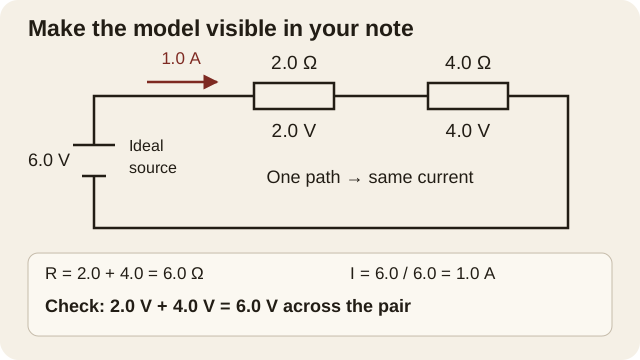
A practical template contains the idea, representation, equation, example and warning. For series resistance, the idea is that the same current passes through components in a single path. The representation is a labelled circuit. The relationship is total resistance equals the sum of the individual resistances, for the components and conditions being modelled.
The worked example should explain why that relationship applies before substituting values. The warning might be “Do not add currents at successive points in one series path.” Leave a small space for a later correction. There is no requirement to squeeze a complex topic onto exactly one page: remove repetition, but keep enough detail to reconstruct the reasoning independently.
Make the worked example carry the explanation
Consider an ideal 6.0 V supply connected to 2.0 Ω and 4.0 Ω resistors in series. Total resistance is 6.0 Ω, so the current is 6.0/6.0 = 1.0 A. The potential differences are 2.0 V and 4.0 V. They add to the supply potential difference. That final comparison checks the model as well as the arithmetic.
Annotate the decision that a student might miss: the 6.0 V belongs across the complete pair, not across each resistor. Then change one feature in a practice version, such as increasing the second resistance. Predict the direction of the current change before calculating. A note becomes more useful when it explains which quantity changes and why, instead of preserving one numerical answer.
Draw diagrams from meaning and label what matters
A diagram should answer a question. Put arrows on a force diagram because direction matters; label axes on a graph because slope and area depend on the plotted quantities. Redrawing a colourful illustration without identifying its information can consume time without revealing understanding. Use a small number of labels that directly support the explanation beside it.
For a circuit note, identify the junctions and component connections clearly. For a ray diagram, include arrow direction and the relevant optical reference lines. For an A-Level model, state an assumption such as negligible resistance in connecting wires. Close the source, redraw the diagram, and compare it with the original. Missing labels are a useful diagnosis, not a reason to rewrite the whole notebook.
Turn the page into a test you can actually fail
Place prompts in the margin or on the reverse: “Why is the current the same?”, “Where is the supply voltage applied?” and “What would invalidate this ideal model?” Answer before revealing the note. If you only recognise the correct statement after reading it, record that as recognition rather than successful recall. The distinction helps you decide what needs another attempt.
Next attempt a related question without the example visible. A factual recall question checks the statement; a changed calculation checks whether you can select and apply it. Retrieval research supports attempting to recall material, but this particular note format is an academy study suggestion, not a guaranteed method validated for every Physics exam. Judge its usefulness by what you can do afterward.
Update only the part that practice proves is missing
After marking a question, identify the smallest repair. If the algebra failed, add one rearrangement step. If the model failed, add a contrast example. If you misread milliamperes, put a conversion warning beside the substitution. Copying the entire page again can obscure the precise reason you lost the mark and postpone the next useful practice attempt.
Maintain a short index linking each note to its syllabus area and a few completed questions. Archive superseded versions so contradictory notes do not remain equally visible. Before an exam, use this index to choose a weak task rather than rereading from the first page. If several problems expose the same conceptual gap, bring the note and your attempts to a teacher for focused help.
Questions, explained
Choose a question for a direct answer, then explore the explanation and supporting resources. Each answer has its own link to save or share.
Do I need to make my own Physics notes?
You do not need to rewrite a complete textbook. Use accurate existing notes, then make short personal additions for decisions, misunderstandings and examples you need to revisit. A useful test is whether your notes help you complete a fresh question without looking at the worked answer.
How long should Physics revision notes be?
There is no useful universal page limit. Give each note one clear task and include the minimum explanation, diagram, conditions and example needed to reconstruct it. Split a page that mixes several unrelated tasks; expand a note if its brevity removes an essential reasoning step.
Are handwritten or digital Physics notes better?
Choose the format that lets you draw clearly, write equations, find a topic and hide answers for practice. Neither format automatically creates understanding. Test your choice by recalling an explanation and solving a new question, rather than judging the notes by appearance or typing speed.
Should I finish my Physics notes before starting past papers?
You can begin suitable topic questions before the whole course is summarised. Learn enough to attempt a small task, check the attempt, and use the result to improve the relevant note. Save unfamiliar full timed papers for a stage when their syllabus coverage makes the score interpretable.
Should I use lots of colours in Physics revision notes?
Use colour for a consistent purpose, such as distinguishing given information from calculated values or showing a correction. A readable diagram and explicit reasoning matter more than a colour scheme. Stop formatting when it no longer helps you retrieve or apply the content.